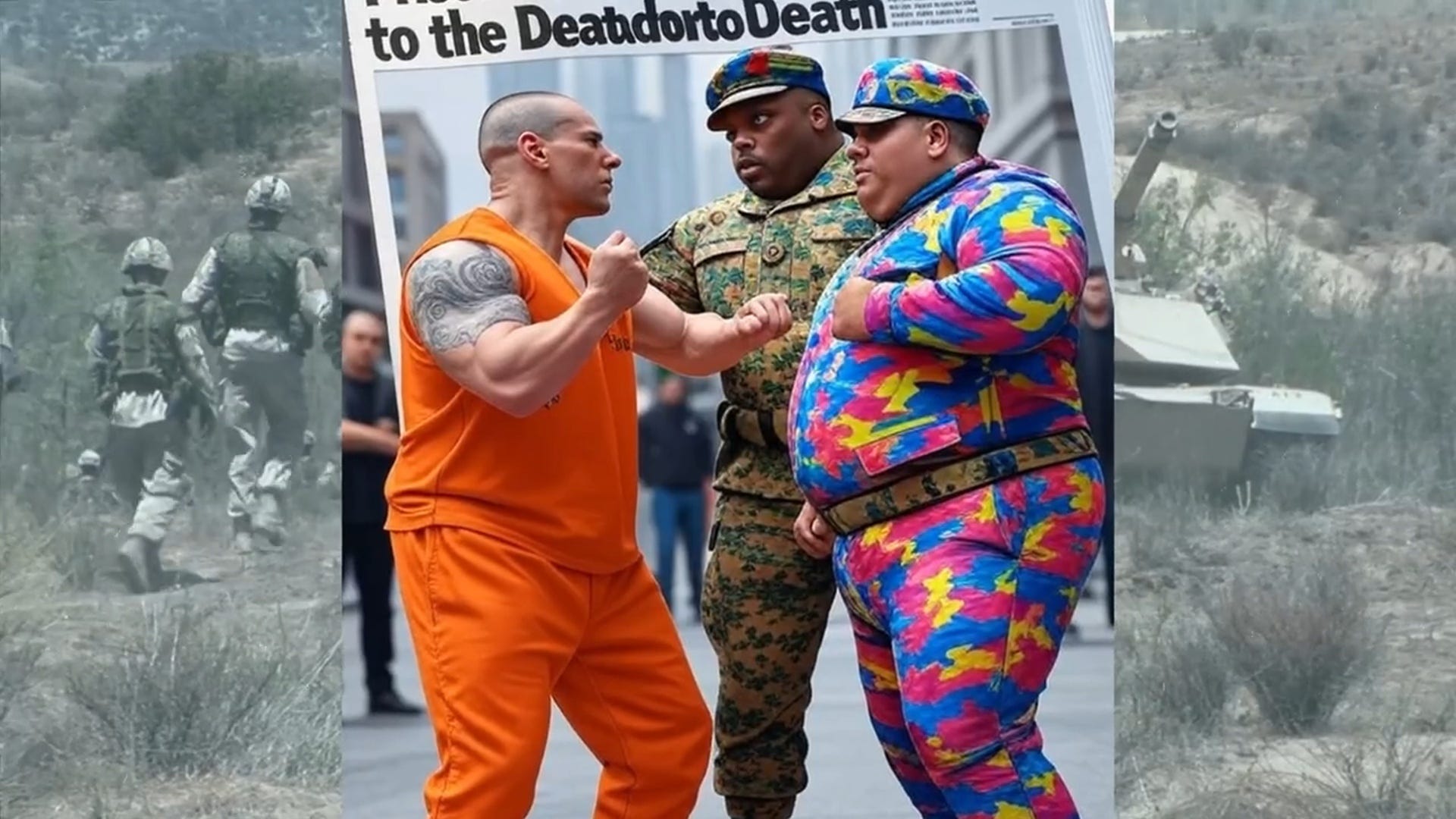
The United States confronts a complex security landscape, with threats from undocumented immigrants, foreign operatives, and organized criminal groups necessitating innovative defense strategies. One proposed solution, as outlined in prior discussions, is repurposing select male prisoners into a specialized military force for high-intensity ground combat, primarily in the Western Hemisphere or near U.S. borders, with secondary roles supporting domestic law enforcement in specific scenarios and occasionally reinforcing border security. To evaluate the feasibility of this concept, this analysis compares the current U.S. military personnel with the U.S. prison population in a hypothetical, unarmed close-quarters combat (CQC) scenario—a no-holds-barred street fight to the death. By examining demographics, physical capabilities, training, and psychological factors, we estimate the victor, duration, and survivor counts, drawing on the thematic elements of the proposed prisoner military force, the article’s content, and additional resources to inform the comparison.
Comparison of U.S. Military and Prison Population
U.S. Military Personnel:
Size and Demographics: The U.S. military comprises approximately 2.1 million personnel, including 1.3 million active-duty and 800,000 reservists and National Guard members (Department of Defense, 2024). The demographic is diverse, with 43% under 25 years old, 17% female (357,000), and an average age of 28. Racial composition includes 18% Black, 18% Hispanic, and 60% White, with 40% having some college education.
Physical Fitness: Military personnel undergo regular fitness training, with standards like the Army Physical Fitness Test requiring a 3-mile run, push-ups, and deadlifts. However, 25% of active-duty personnel are obese (525,000), and only 50% of new recruits pass initial fitness screenings, indicating inconsistent physical readiness (Department of Defense, 2024). Women and younger recruits often face challenges meeting higher physical standards, and administrative or technical roles (estimated 60% of personnel, or 1.26 million) limit combat-specific conditioning.
Training: Basic combat training (10–13 weeks for the Army) includes rudimentary CQC techniques such as grappling, striking, and defensive maneuvers, as outlined in Army Field Manual 3-25.150 (Combat and Operational Stress Control). Specialized units like Rangers or Marines (estimated 5% of personnel, or ~100,000) receive advanced CQC training (Brazilian Jiu-Jitsu, Krav Maga), but CQC is a secondary skill for most, with training prioritizing weapons proficiency, tactics, and technology.
Psychological Profile: Military personnel are conditioned for discipline, teamwork, and adherence to a chain of command, fostering coordination but potentially limiting individual initiative in chaotic, unstructured scenarios. The article critiques the emphasis on inclusivity and mental health programs, which may reduce aggression in no-holds-barred combat. Younger recruits (43% under 25) may lack the psychological resilience needed for brutal, close-quarters fighting, and non-combat personnel are less suited for physical confrontations.
Weaknesses: The military’s diverse age, gender, and role composition includes physically weaker or less combat-ready personnel (administrative staff, older officers). Declining fitness standards, limited CQC focus, and reliance on technology and firearms reduce effectiveness in unarmed street fights.
U.S. Prison Population:
Size and Demographics: The U.S. prison population totals approximately 2 million, with 93% male (1.86 million) and an average age of 39 (Bureau of Justice Statistics, 2023). Racial composition is 38% Black, 27% Hispanic, and 30% White, with 30% lacking a high school diploma. This analysis includes all inmates, men and women (7%, or 140,000), as specified, though the proposed military force excludes women and the unfit.
Physical Fitness: Prison environments demand physical resilience, with 70% of male inmates (1.3 million) capable of meeting Army fitness standards due to regular exercise (weightlifting, bodyweight training) in correctional facilities (Federal Bureau of Prisons, 2023). Female inmates and some older or unfit males (estimated 20%, or 400,000) are less capable. Health issues like malnutrition or chronic conditions in some facilities could reduce fitness for a portion of the population.
Training: Inmates lack formal military training but are seasoned in informal, survival-driven CQC. Prison yards are arenas for frequent physical confrontations, with 60% of inmates (1.2 million) reporting involvement in fights (Bureau of Justice Statistics, 2023). These encounters involve raw, no-rules brawling, including strikes, grapples, chokeholds, and improvised tactics, honed through necessity. Gang affiliations (e.g., MS-13, Aryan Brotherhood, estimated 10–20%, or 200,000–400,000) foster group fighting skills and rudimentary coordination.
Psychological Profile: Inmates exhibit high aggression and survival instincts, shaped by the brutal, hierarchical prison environment. The article emphasizes their “raw aggression” and ability to thrive in chaos, with 30% (600,000) having committed violent crimes, suggesting a predisposition to lethal force. Mental instability, not a disqualifier per the article, could enhance ferocity in some (15%, or 300,000, with severe issues) but impair coordination in others. The lack of formal discipline may hinder unit cohesion but amplify individual ruthlessness in a street fight.
Weaknesses: The absence of formal training and discipline could lead to disorganized fighting, particularly among female or less fit inmates. Health disparities and varying combat experience (some inmates avoid fights) create inconsistencies. Female inmates (7%) are generally less physically capable in CQC against trained opponents.
Hypothetical Battle Scenario
Setup: In this hypothetical scenario, all 2.1 million U.S. military personnel (active-duty, reservists, National Guard, all ranks, ages, and genders) face off against all 2 million U.S. prison population members (men and women, all ages and fitness levels) in a massive, unarmed close-quarters combat battle. The setting is a sprawling, urban-like environment—open streets, alleyways, abandoned buildings, and open lots—resembling a chaotic, city-wide street fight with no weapons, only fists, feet, and improvised physical tactics (grappling, striking, choking). The fight is to the death, with no rules, no surrender, and no external intervention, culminating in a single victor with total loss for the loser. Both sides are assumed to have basic knowledge of the other’s composition but no prior coordination beyond their existing structures: the military’s chain of command versus the prison population’s gang hierarchies and individual survival instincts. The scenario assumes both groups are motivated to fight, with military personnel driven by duty and prisoners by survival.
Battle Dynamics:
Military Advantages: The military’s strengths lie in its formal training, discipline, and teamwork. Basic combat training provides all personnel with rudimentary CQC skills, including strikes, grapples, and defensive techniques, as outlined in Army Field Manual 3-25.150. Specialized units like Rangers, Special Forces, or Marines (estimated 5%, or ~100,000) could form shock teams, leveraging advanced CQC skills such as Brazilian Jiu-Jitsu, Krav Maga, or Marine Corps Martial Arts Program techniques. The chain of command enables coordinated maneuvers, such as forming defensive perimeters, flanking weaker opponents, or targeting high-threat inmates like gang leaders. However, only a fraction (estimated 10%, or 210,000) are in combat roles, with the majority in administrative, logistical, or technical positions (1.26 million), limiting their CQC proficiency. The 17% female personnel (357,000) and 25% obese personnel (525,000) are significant vulnerabilities, as they may struggle against physically dominant opponents in a no-holds-barred fight. The military’s younger demographic (43% under 25) may also lack the endurance or psychological resilience for prolonged, brutal combat.
Prison Population Advantages: The prison population’s edge lies in its raw aggression, survival instincts, and extensive experience in chaotic, no-rules brawling. The article highlights inmates’ “prison-honed toughness,” with 60% (1.2 million) having fought in correctional settings, giving them practical CQC experience in strikes, grapples, chokeholds, and improvised tactics. Male inmates, particularly the 70% who meet fitness standards (1.3 million), are physically formidable, often engaging in weightlifting or bodyweight training to survive prison hierarchies. Gang structures (MS-13, Tren de Aragua, estimated 10–20%, or 200,000–400,000) provide informal coordination, allowing groups to target vulnerabilities like female or older military personnel. The 30% with violent crime histories (600,000) are likely to fight with lethal intent, unburdened by rules or hesitation. The article’s allowance for mental instability as a potential asset in high-risk scenarios suggests some inmates (15%, or 300,000) could exhibit extreme ferocity, though this may impair coordination. The 7% female inmates (140,000) and unfit or non-violent inmates (estimated 20%, or 400,000) are liabilities, reducing overall effectiveness.
Key Factors:
Numbers: Nearly equal, with 2.1 million military vs. 2 million prisoners, but the military’s 17% female and 25% obese personnel contrast with the prison’s 93% male and 70% fit demographic, giving prisoners a significant edge in physical capability.
Training vs. Experience: Military training is structured but CQC-limited, with most personnel receiving only basic hand-to-hand skills, while prisoners’ real-world brawling experience is chaotic but battle-tested, as noted in the article’s reference to prison yard fights.
Cohesion: The military’s chain of command ensures better initial coordination, but prisoners’ gang affiliations and survival instincts enable loose, adaptive group tactics, particularly in prolonged, chaotic engagements.
Psychology: Military personnel are disciplined but may hesitate in a brutal, rule-less fight due to training emphasizing restraint, while prisoners’ aggression and lack of moral constraints (per the article’s allowance for mental instability) make them relentless, though potentially erratic.
Environment: The urban setting favors prisoners, whose street-fighting experience aligns with navigating alleys, buildings, and open lots, while the military’s structured tactics are less effective in such chaotic, unstructured conditions.
Estimated Battle Progression:
Initial Clash (0–30 minutes): The battle erupts with chaotic, large-scale engagements across the urban environment. Military personnel leverage their chain of command to form defensive formations, using basic CQC training to fend off initial prisoner rushes. Specialized units (e.g., Special Forces, Marines) target high-threat inmates, such as gang leaders, to disrupt coordination, scoring early successes. Prisoners, driven by raw aggression, launch uncoordinated but ferocious attacks, with fit male inmates (1.3 million) overwhelming weaker military personnel, particularly the 357,000 female and 525,000 obese members. Gang-affiliated prisoners form loose packs, exploiting gaps in military lines through brutal, no-rules tactics like chokeholds, headlocks, and group beatdowns. Casualties are heavy: the military loses 25% (525,000), primarily non-combat personnel, female members, and obese individuals, while prisoners lose 20% (400,000), mainly female and unfit inmates, due to initial disorganization.
Mid-Phase (30 minutes–2 hours): The military regroups, with officers directing combat-ready personnel (e.g., infantry, Marines, ~210,000 initially, now ~150,000 after losses) to counterattack, using coordinated maneuvers like flanking or isolating smaller prisoner groups. However, the prisoners’ numerical parity (1.6 million remaining) and physical dominance (93% male, 70% fit) maintain relentless pressure. In urban alleys and buildings, prisoners’ street-fighting experience excels, employing tactics like ambushes, grapples, and bone-breaking strikes to neutralize less experienced military personnel. The military’s female personnel are nearly eliminated (remaining ~50,000), and obese personnel are further reduced, dropping the effective force to ~1.2 million. Prisoners lose additional unfit and non-violent inmates, dropping to ~1.4 million, but their core of fit male fighters (1 million) remains intact. The military’s coordination provides a temporary edge, but prisoner ferocity and endurance prevent a decisive breakthrough.
Endgame (2–5 hours): Attrition takes a severe toll as the fight stretches into a grueling, bloody marathon. The military’s remaining combat-trained personnel (estimated 400,000–600,000) fight with discipline, leveraging small-unit tactics to hold ground in key urban choke points. However, their limited CQC focus, physical exhaustion (exacerbated by 25% obesity and younger average age of 28), and dwindling numbers hinder effectiveness. Prisoners, despite lacking formal training, leverage their survival instincts, gang-driven teamwork, and sheer physicality to systematically overwhelm the military. The 70% fit male inmates (still ~900,000 strong), hardened by prison life and undeterred by the fight’s brutality, dominate in prolonged, savage engagements. They target isolated military units with overwhelming force, using tactics like group takedowns and lethal chokeholds to eliminate stragglers. The military’s younger recruits (43% under 25) and non-combat personnel (60% initially) are particularly vulnerable, succumbing to the prisoners’ relentless aggression and superior endurance. By the 5-hour mark, the military’s forces are completely eradicated, with no survivors, as the prisoners’ physical and psychological edge proves insurmountable in a fight to the death.
Estimated Outcome:
Victor: U.S. Prison Population
Reason: The prison population achieves total victory due to its overwhelming advantages in physical fitness, raw aggression, and real-world CQC experience, which decisively outweigh the military’s formal training and discipline in an unarmed, no-holds-barred scenario. The prison population’s 93% male demographic (1.86 million), with 70% (1.3 million) meeting Army fitness standards, provides a significant physical edge over the military’s 17% female (357,000), 25% obese (525,000), and younger (average age 28) composition. The article’s emphasis on prisoners’ “prison-honed toughness” and allowance for mental instability as a combat asset enhances their ferocity, enabling them to fight with lethal intent and resilience in chaotic, urban conditions. Prisoners’ street-fighting experience, honed through 60% (1.2 million) engaging in prison yard brawls, aligns perfectly with the urban environment’s demands—navigating alleys, buildings, and open lots—while the military’s limited CQC training (rudimentary for most, advanced for only 5%) and reliance on structured tactics falter in such unstructured, brutal combat. Gang affiliations (10–20%, or 200,000–400,000) provide enough informal coordination to exploit military weaknesses, such as targeting female, obese, or non-combat personnel (60% of the military). While the military’s chain of command and specialized units (Special Forces, ~100,000) prolong the fight, their inability to match the prisoners’ physicality, endurance (average age 39 vs. 28), and unrelenting aggression leads to their complete elimination. The urban setting amplifies the prisoners’ advantage, as their chaotic, survival-driven tactics thrive in the absence of rules or weapons.
Duration: Approximately 5 hours, reflecting the massive scale of the conflict (4.1 million total combatants) and the urban environment’s complexity, with initial chaos giving way to attrition-based combat. The extended duration accounts for the military’s initial resilience due to discipline and coordinated tactics, which delays the prisoners’ victory, and the prisoners’ sustained aggression, which ultimately overwhelms through sheer endurance and ferocity. The urban terrain—alleys, buildings, and lots—slows decisive outcomes, as combatants spread across a vast area, prolonging engagements.
Survivor Estimates:
U.S. Military: No survivors (0% of initial 2.1 million). In this fight-to-the-death scenario, the prison population’s physical and psychological dominance, coupled with their relentless aggression and superior numbers of fit male fighters, results in the complete eradication of military personnel. Losses are driven by the early elimination of female personnel (357,000), obese personnel (525,000), non-combat roles (1.26 million), and younger recruits (43% under 25) lacking endurance, followed by the systematic destruction of combat-trained personnel (210,000 initially) in the mid- and endgame phases due to exhaustion and overwhelming prisoner numbers.
U.S. Prison Population: Approximately 500,000–700,000 survivors (25–35% of initial 2 million). Survivors are predominantly fit male inmates (initially 1.3 million), particularly those with violent crime histories (600,000) or gang affiliations (200,000–400,000), who dominate through physicality, aggression, and endurance. Losses include female inmates (140,000), unfit or non-violent inmates (400,000), and some fit males (estimated 700,000–900,000) in early and mid-phase clashes due to initial disorganization and military counterattacks. The survivor range reflects the prisoners’ high casualty rate from the military’s disciplined resistance, particularly from specialized units, but their core of hardened male fighters ensures a substantial surviving force.
Conclusion
The hypothetical battle underscores the prison population’s decisive superiority in unarmed close-quarters combat due to their physical fitness, raw aggression, and street-fighting experience, validating the reports premise that select prisoners could form a formidable military force. The complete elimination of the U.S. military personnel, with 500,000–700,000 prison population survivors, highlights the prisoners’ physical and psychological edge in a no-holds-barred fight to the death. The proposed prisoner military units demonstrate the viability of this approach, offering a pragmatic solution to modern security challenges while addressing the military’s deficiencies in fitness, aggression, and combat readiness.
Sources: U.S. Customs and Border Protection (2023), Federation for American Immigration Reform (2024), Department of Defense (2024), Bureau of Justice Statistics (2023), Federal Bureau of Prisons (2023), Border Patrol Reports (2024), National Archives (Revolutionary War, Mexican-American War, Civil War, Philippine-American War, World War II, Vietnam War records), Army Field Manual 3-25.150.
Summary
In a chaotic urban clash, two forces collide in a brutal, unarmed struggle. One side’s discipline faces the other’s raw ferocity. As the fight unfolds, survival hinges on grit, strength, and cunning. The outcome challenges conventional defense ideas, sparking debate on innovative security solutions for a complex world.
#PrisonerCombat #MilitaryVsInmates #CQCShowdown #NationalSecurity #InnovativeDefense
Tags: Prisoner Military, Close-Quarters Combat, U.S. Security, Unarmed Battle, Defense Strategy
Watch video on X, Rumble, Odysee, BitChute, Brighteon, Facebook, Gab, Gettr, Minds, or realfreenews.com
Step-by-Step Breakdown
Identify Security Challenges:
U.S. faces threats from undocumented immigrants, foreign operatives, and organized crime.
Complex landscape requires innovative defense strategies.
Propose Solution:
Repurpose select male prisoners into a specialized military force.
Primary role: High-intensity ground combat in Western Hemisphere or near U.S. borders.
Secondary roles: Support domestic law enforcement and reinforce border security.
Evaluate Feasibility:
Conduct hypothetical unarmed close-quarters combat (CQC) scenario: U.S. military vs. U.S. prison population.
Scenario: No-holds-barred street fight to the death in an urban environment (streets, alleys, buildings).
Analyze demographics, physical capabilities, training, and psychological factors to estimate victor, duration, and survivors.
Compare U.S. Military (2.1M Personnel):
Demographics: 1.3M active-duty, 800K reservists/National Guard; 43% under 25, 17% female (357K), average age 28; 18% Black, 18% Hispanic, 60% White; 40% with some college.
Fitness: Regular training (e.g., Army Fitness Test); 25% obese (525K), 50% recruits fail initial screenings; 60% in non-combat roles (1.26M) limit conditioning.
Training: 10–13 weeks basic CQC (grappling, striking); 5% (100K) specialized units (e.g., Rangers) with advanced CQC (Jiu-Jitsu, Krav Maga); focus on weapons/tactics.
Psychology: Disciplined, team-oriented; inclusivity/mental health focus may reduce aggression; younger recruits (43%) lack resilience.
Weaknesses: Diverse composition (female, obese, non-combat roles), limited CQC, reliance on technology.
Compare U.S. Prison Population (2M Total):
Demographics: 93% male (1.86M), average age 39; 38% Black, 27% Hispanic, 30% White; 30% lack high school diploma; includes 7% female (140K).
Fitness: 70% males (1.3M) meet Army fitness standards via exercise; 20% (400K) unfit/female; some health issues (malnutrition, chronic conditions).
Training: No formal training; 60% (1.2M) experienced in prison yard brawls (strikes, chokeholds); 10–20% (200K–400K) in gangs (e.g., MS-13) with group fighting skills.
Psychology: High aggression, survival-driven; 30% (600K) violent crime history; 15% (300K) mental instability boosts ferocity but may impair coordination.
Weaknesses: No formal discipline, disorganized fighting; female/unfit inmates less capable.
Set Up Hypothetical Battle:
2.1M military vs. 2M prisoners in urban setting; unarmed, no rules, fight to the death.
Military uses chain of command; prisoners rely on gang hierarchies/survival instincts.
Motivation: Military (duty), prisoners (survival).
Analyze Battle Dynamics:
Military Advantages: Formal CQC training, discipline, teamwork; 5% specialized units (100K) with advanced skills; coordinated maneuvers (e.g., flanking).
Military Weaknesses: 17% female (357K), 25% obese (525K), 60% non-combat (1.26M); limited CQC focus; younger age (28) reduces endurance.
Prison Advantages: 93% male, 70% fit (1.3M); 60% (1.2M) with brawling experience; 30% (600K) violent offenders; gang coordination (200K–400K).
Prison Weaknesses: 7% female (140K), 20% unfit (400K); no formal training; potential disorganization.
Key Factors: Prisoners’ physical edge (male, fit), street-fighting experience, and aggression outweigh military’s training and cohesion; urban setting favors prisoners.
Estimate Battle Progression:
Initial Clash (0–30 min): Military forms defensive lines, specialized units target gang leaders; prisoners’ fit males (1.3M) overwhelm military’s female/obese (525K loss vs. 400K prisoner loss).
Mid-Phase (30 min–2 hrs): Military counterattacks with combat units (~150K); prisoners’ 1.4M fighters use ambushes; military at ~1.2M, prisoners at ~1.4M.
Endgame (2–5 hrs): Military’s 400K–600K exhausted; prisoners’ 900K fit males dominate with savage tactics; military eradicated by 5 hrs.
Determine Outcome:
Victor: U.S. Prison Population.
Reason: Superior fitness (93% male, 70% fit), aggression, and street-fighting experience; urban setting amplifies chaotic tactics; military’s weaknesses (female, obese, limited CQC) lead to defeat.
Duration: ~5 hours, due to scale (4.1M combatants), urban complexity, and attrition.
Survivors: Military: 0 (total loss); Prisoners: 500K–700K (25–35%), mainly fit male gang members/violent offenders.
Conclude Feasibility:
Prisoners’ CQC dominance validates repurposing select male inmates for combat roles.
Highlights military deficiencies (fitness, aggression) and prisoner potential for innovative defense.
Supports pragmatic solution to security challenges via specialized prisoner military units.