
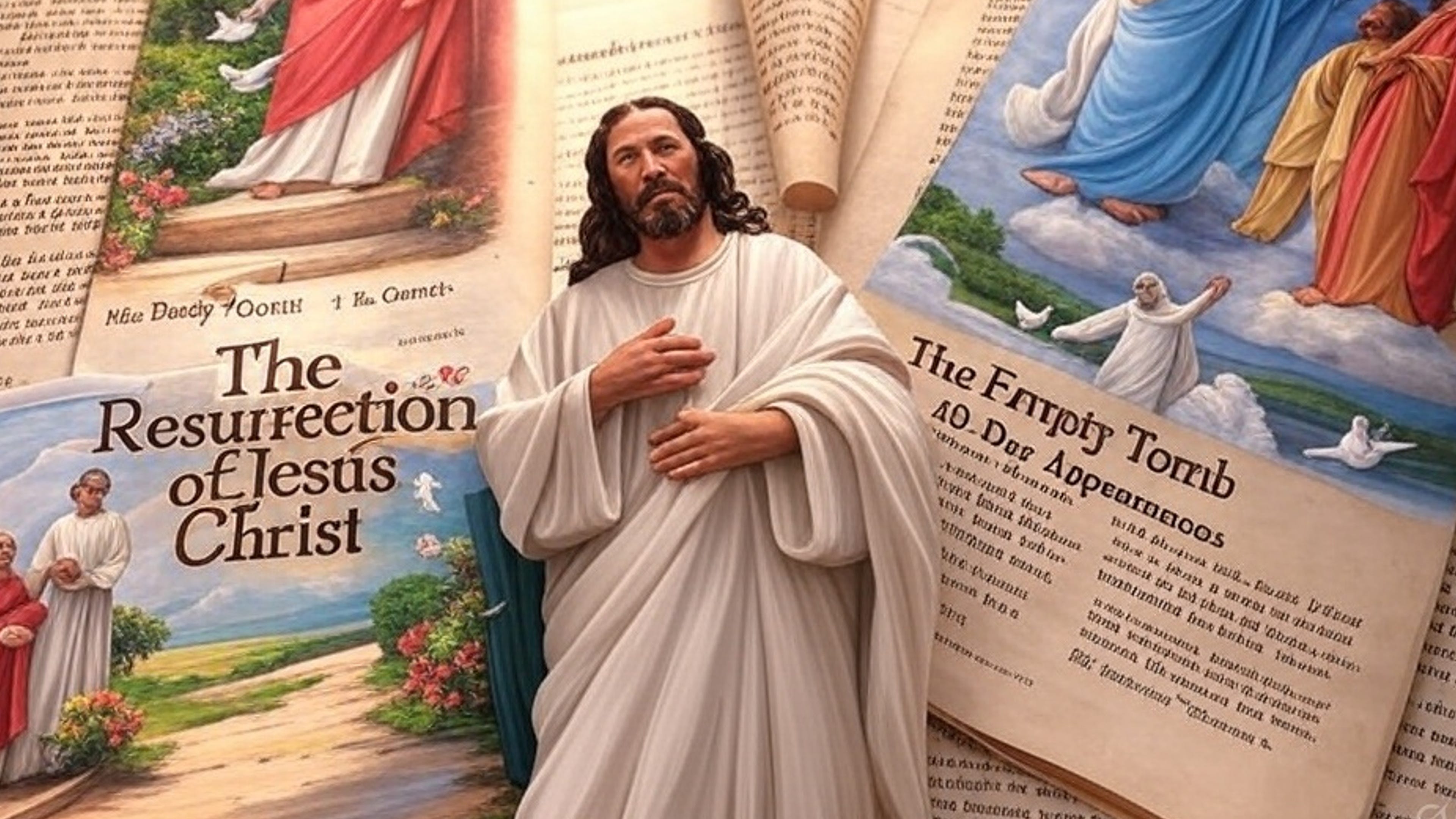
The resurrection of Jesus Christ stands as the foundational doctrine of Christianity, a transformative event celebrated through Easter that proclaims victory over death and the promise of eternal life. This essay examines the multifaceted narrative of Jesus’ resurrection as presented in the New Testament, exploring its theological significance, historical context, cultural evolution, and the debates surrounding its veracity. From the empty tomb to the 40-day period of post-resurrection appearances, the Ascension, and the broader context of 1st-century Jewish burial practices and resurrection beliefs, the story engages profound questions of faith, skepticism, and historical reliability. By analyzing the biblical accounts, their authorship, alternative explanations for the empty tomb, and the development of Easter as a religious and cultural phenomenon, this essay offers a comprehensive perspective on why the resurrection remains central to Christian identity, bridging ancient texts with modern observance.
The Biblical Narrative of the Resurrection
The New Testament provides a detailed account of Jesus’ crucifixion, burial, resurrection, and subsequent activities, forming the basis for Christian belief and the celebration of Easter. According to the Gospels of Matthew, Mark, Luke, and John, Jesus was crucified on a Friday, the day of Preparation for the Sabbath, and died around 3 p.m. He was buried before sunset in a new rock-hewn tomb provided by Joseph of Arimathea, a wealthy follower, to comply with Jewish burial laws requiring interment before the Sabbath. On Sunday morning, the third day, women such as Mary Magdalene discovered the tomb open and empty, with angels announcing that Jesus had risen. This event, occurring approximately 36 to 40 hours after his death, is counted as “three days” in Jewish reckoning, which includes partial days, fulfilling Jesus’ predictions of rising after three days and echoing prophetic imagery like Jonah’s three days in the fish.
The empty tomb serves as the primary evidence of the resurrection, but Jesus’ appearances to his disciples and others provide further confirmation. Over the next 40 days, as recorded in Acts, Jesus appeared to Mary Magdalene, the Eleven disciples, two travelers on the road to Emmaus, and over 500 believers, engaging in physical acts such as eating fish and allowing Thomas to touch his crucifixion wounds to prove his bodily return. He taught about the kingdom of God, explained how his death and resurrection fulfilled Scripture, and commissioned his disciples to preach repentance and forgiveness to all nations. These encounters, detailed in Luke, John, Matthew, and the longer ending of Mark, transformed the disciples from fearful deserters to bold proclaimers, many of whom faced martyrdom for their testimony.
The 40-Day Period and the Ascension
The 40-day period following the resurrection, explicitly noted in Acts, represents a critical phase in which Jesus prepared his followers for their mission. He appeared in various settings—Jerusalem, Galilee, and along the road to Emmaus—demonstrating his glorified body’s capabilities, such as appearing in locked rooms and vanishing suddenly. His teachings focused on the fulfillment of Old Testament prophecies and the establishment of the church, culminating in the Great Commission to make disciples of all nations. This period, while significant, is less emphasized in Christian liturgy compared to the crucifixion and resurrection, as it serves a preparatory role for the church’s empowerment at Pentecost.
The 40 days concluded with the Ascension, described in Luke and Acts as Jesus being lifted up into a cloud while blessing his disciples at Bethany or the Mount of Olives. This divine act of exaltation, not a physical flight or teleportation, marked Jesus’ transition to his heavenly role at God’s right hand, where he intercedes for believers and prepares for his promised return. The cloud, a Jewish symbol of divine presence, and the upward movement, signifying transcendence, underscore the event’s theological weight. Heaven, in this context, is not a physical location in the sky but God’s spiritual realm, beyond earthly coordinates. Ascension Day, observed 40 days after Easter, commemorates this moment, though its midweek timing and secondary theological role make it less prominent than Easter or Christmas, which celebrate the Incarnation and resurrection, respectively.
1st-Century Jewish Burial Practices and the Tomb
The resurrection narrative is deeply intertwined with 1st-century Jewish burial practices, which provide critical context for understanding Jesus’ tomb and its significance. In Judea during the Second Temple period, rock-hewn tombs were a common burial method for the wealthy, carved into limestone hills with niches or shelves to hold bodies. Jesus’ tomb, owned by Joseph of Arimathea, was new and unused, containing no other bodies, a detail emphasized in Luke and John to ensure clarity in the resurrection account. These tombs were sealed with large, disk-shaped rolling stones, requiring multiple people to move, and were designed for family use over generations, with new bodies added as needed.
Jewish burial followed a two-stage process. In the primary burial, the body, wrapped in a linen shroud and anointed with spices, was placed in a niche for about a year until the flesh decomposed, reflecting the natural return to dust while preserving bones for resurrection. In the secondary burial, bones were collected into ossuaries—small limestone boxes inscribed with the deceased’s name—or bone chambers within the same tomb. Ossuaries, prevalent in Judea from approximately 20 BCE to 70 CE, were stored on shelves or in corners, serving as the final resting place, rarely moved except in exceptional cases like family relocation. This practice, rooted in respect for the dead and belief in bodily resurrection, involved no elaborate ceremonies but was performed with care by family members, who saw decomposing bodies during new burials, a normalized duty mitigated by shrouds and spices.
Jesus’ burial aligned with primary burial customs, with his body wrapped and anointed, but the resurrection on Sunday morning, within 36 to 40 hours, precluded decomposition or secondary burial. The new tomb’s emptiness, discovered by the women, underscored the resurrection’s uniqueness, as no ossuary or bone chamber was needed. The tomb’s design and the absence of other bodies eliminated confusion, reinforcing the biblical claim that Jesus rose and left immediately, not lingering for three days.
Historical Reliability and Skeptical Challenges
The New Testament accounts, written between 65 and 100 CE, are the primary sources for the resurrection, traditionally attributed to disciples or their associates but considered anonymous by modern scholars. Composed 30 to 70 years after Jesus’ death, these texts rely on oral traditions, a reliable method in Jewish culture, and possibly earlier sources, with Paul’s testimony in 1 Corinthians predating the Gospels. Their consistency on the empty tomb and appearances, supported by the rapid spread of Christianity and disciples’ martyrdom, suggests a robust tradition. Non-Christian sources, such as Josephus’ Antiquities and Tacitus’ Annals, confirm Jesus’ crucifixion, providing historical context, but lack direct evidence for the resurrection, leaving room for debate.
Skeptics question the accounts’ reliability due to their anonymity, theological agendas, and minor discrepancies, such as the number of angels at the tomb. The absence of contemporary non-Christian corroboration and the miraculous nature of the claims further challenge historical verification. A significant counter-narrative appears in Matthew 28:11–15, where Jewish chief priests and elders bribed Roman soldiers to claim that the disciples stole Jesus’ body while they slept, a story that persisted among some Jews. This passage, unique to Matthew, portrays the theft hypothesis as a fabricated lie, highlighting the empty tomb’s impact and the leaders’ rejection of the resurrection. The inclusion of women as witnesses, less credible in 1st-century Judea, adds authenticity, as fabricated stories might prioritize male testimony.
Alternative Explanations for the Empty Tomb
The New Testament attributes the tomb’s opening to divine power, with Matthew describing an angel rolling back the stone amid an earthquake, while other Gospels note the stone already moved. Skeptical theories offer nat uralistic explanations, each facing significant challenges. The theft hypothesis, echoed in Matthew 28:11–15, suggests disciples stole the body, possibly bribing or evading guards, but their subsequent persecution and Roman military discipline undermine this. The swoon theory posits Jesus survived crucifixion, reviving and escaping, but Roman execution methods, including a spear wound, make survival unlikely. Other proposals include the women visiting the wrong tomb, authorities moving the body, or the resurrection being a hallucination or later legend, yet these struggle to account for the diverse appearances and the disciples’ transformed conviction.
A speculative “Jesus double” theory, suggesting an impostor mimicked Jesus post-resurrection, lacks textual or historical support. The Gospels emphasize recognizable wounds, intimate encounters, and supernatural traits, such as appearing in locked rooms, which a double could not convincingly replicate. Coordinating multiple appearances to hundreds over 40 days without detection by disciples or enemies is improbable, especially under Roman and Jewish scrutiny. These alternatives, while addressing skepticism, require complex conspiracies and fail to explain the rapid growth of Christianity or the empty tomb’s early prominence.
Jewish Resurrection Beliefs and Christian Divergence
The resurrection narrative is contextualized by 1st-century Jewish beliefs in bodily resurrection, particularly among Pharisees, who expected the righteous to rise physically in the messianic age, living again on a renewed earth. Texts like Daniel 12:2 and 2 Maccabees 7:9 articulate this hope, with the righteous, and possibly righteous Gentiles, rising to eternal life, while the wicked might face judgment. This belief influenced burial practices, with ossuaries preserving bones as the framework for resurrected bodies. Sadducees rejected resurrection, focusing on this life, but Pharisaic views dominated, shaping the cultural backdrop for Jesus’ claims.
Jesus’ resurrection, occurring immediately rather than at the end of days, diverged from Jewish expectations, presenting him as the “firstfruits” of the resurrection. His 40-day earthly stay and Ascension to heaven, rather than remaining on earth, further distinguished Christian theology, emphasizing a heavenly exaltation. Post-Ascension appearances, limited to visions like Paul’s on the road to Damascus, reinforced the expectation of a future Second Coming, aligning with but transforming Jewish eschatological hopes. This divergence fueled skepticism among some Jews, as seen in Matthew 28:11–15, who rejected an individual resurrection before the messianic age.
The Cultural and Commercial Evolution of Easter
Easter’s celebration, rooted in the resurrection, evolved from 1st-century Passover-linked observances to a global Christian feast, formalized by the 2nd century and standardized in 325 CE at the Council of Nicaea. Early practices included vigils, baptisms, and Eucharistic meals, reflecting the resurrection’s transformative power. By the 4th century, Holy Week—Palm Sunday, Maundy Thursday, Good Friday, and the Easter Vigil—structured the liturgical calendar, with Lent’s fasting culminating in Easter’s joyful hymns. Medieval traditions introduced red eggs, symbolizing Jesus’ blood, and passion plays, while the Reformation saw varied Protestant practices, from Lutheran liturgies to Puritan simplicity.
The commercialization of Easter began in the 19th century, driven by industrialization and Victorian consumerism. Mass-produced chocolate eggs, pioneered by Cadbury in 1842, Easter cards, and German-inspired bunny traditions, symbolizing fertility, emerged as family-friendly symbols. By the 20th century, candy companies and retail giants transformed Easter into a multi-billion-dollar industry, with U.S. spending projected at $22 billion in 2025. Secular traditions—egg hunts, Easter baskets, and bunnies—often overshadow the resurrection’s spiritual significance, prompting critique from Christians seeking to reclaim Easter’s theological core.
The prominence of Easter and Christmas, celebrating the Incarnation and resurrection, overshadows Good Friday and Ascension Day due to their theological weight and cultural appeal. Good Friday, named for its “holy” redemptive outcome, is somber, integrated into Holy Week’s narrative, while Ascension Day’s midweek timing and transitional role reduce its visibility. Epiphany, marking the Magi’s visit, remains a minor feast, reflecting the prioritization of birth and resurrection in Christian liturgy.
Conclusion
The resurrection of Jesus Christ, as narrated in the New Testament, forms the bedrock of Christian faith, celebrated through Easter as a testament to divine power and eternal hope. The empty tomb, 40-day appearances, and Ascension weave a narrative of redemption, grounded in detailed accounts that, despite their anonymity and miraculous claims, resonate with historical context and early Christian conviction. Jewish burial practices, with rock-hewn tombs and ossuaries, provide a cultural backdrop, highlighting the uniqueness of Jesus’ immediate rising. Skeptical theories—from theft to a Jesus double—challenge the narrative but struggle to match its transformative impact, as seen in the disciples’ boldness and Christianity’s growth. Easter’s evolution, from Passover roots to a commercialized global holiday, reflects its enduring significance, even as secular traditions compete with its spiritual essence. The resurrection remains a profound intersection of faith, history, and culture, inviting reflection on the mysteries of life, death, and the possibility of transcendence, a legacy that continues to shape Christian identity two millennia later.
Summary
A transformative event shrouded in mystery, the resurrection of Jesus Christ sparks faith and debate. This essay delves into its biblical roots, historical context, and cultural evolution, from an empty tomb to Easter’s global celebration, exploring why this narrative of divine victory continues to captivate and inspire.
#Resurrection #Easter #ChristianFaith #EmptyTomb #Ascension
Tags: Resurrection, Easter, Christianity, Empty Tomb, Ascension
Watch video on X, Rumble, Odysee, BitChute, Brighteon, Facebook, Gab, Gettr, Minds, or realfreenews.com