
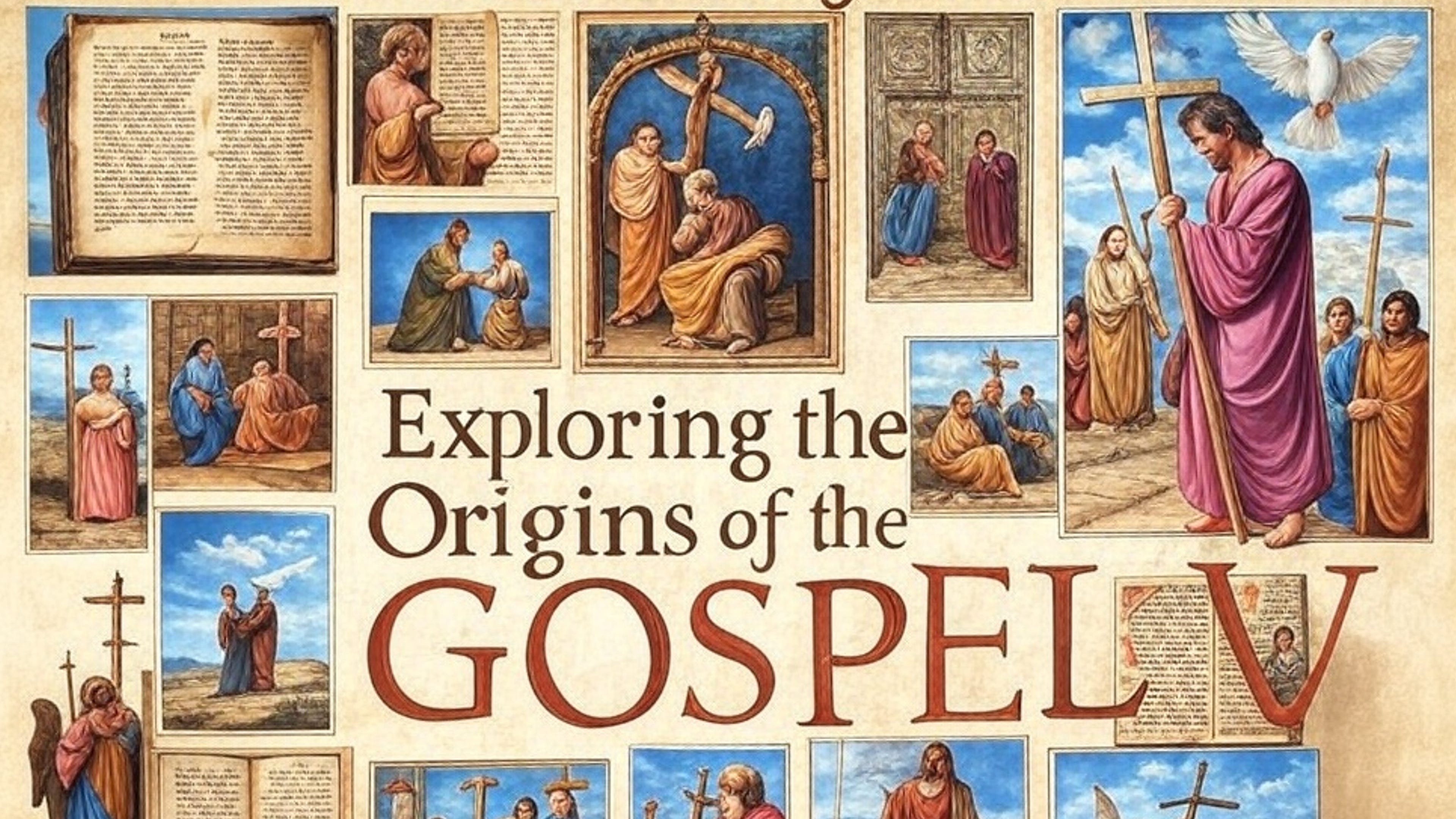
The Authorship and Preservation of the Gospels
Introduction
The Gospels of Matthew, Mark, Luke, and John constitute foundational texts of Christian scripture, traditionally ascribed to the eponymous figures associated with Jesus Christ. However, contemporary biblical scholarship challenges these attributions, suggesting a more complex origin involving anonymous authors within early Christian communities. This essay explores the historical context of these texts, examining their probable composition dates (65–110 CE), the lack of definitive evidence for direct authorship by the named individuals, and the preservation of their earliest manuscripts. By analyzing the oldest extant fragments—such as P52 (John, c. 125–150 CE)—and their current repositories, alongside hypotheses regarding their geographic origins and the roles of scribal intermediaries, this study elucidates the intricate process by which these narratives were transmitted. Such inquiry underscores the interplay between tradition, orality, and textual evolution in shaping sacred literature.
Summary of Key Findings
The Bible was written by multiple authors over centuries, with the Old Testament compiled around 200 BCE and the full Christian Bible by 367 CE. All copies were handwritten until the Gutenberg Bible in 1455 CE. The New Testament’s canon was set by Bishop Athanasius in 367 CE from earlier handwritten documents, though these were not centralized before then. Athanasius finalized the 27-book New Testament, excluding other texts, with councils like Hippo (393 CE) and Carthage (397 CE) affirming it. Jesus died around 30–33 CE, with no immediate records; Paul’s letters (c. 50 CE) and the Gospels (65–110 CE) came later, mostly from disciples’ circles, not them directly. Other accounts include Josephus and apocryphal texts. The Gospels’ traditional authors are doubtful; they’re likely by anonymous community members. Matthew, Mark, Luke, and John died between 60–100 CE, with their books appearing post-mortem. The oldest fragments—P45 (Mark), P1/P64+67 (Matthew), P4 (Luke), P52 (John)—are now in libraries like Chester Beatty and Rylands, written in places like Rome and Ephesus by unknown authors tied to the disciples.
Historical Context and Composition
I. The Historical Context and Composition of the Gospel of Mark
The Gospel of Mark, dated to approximately 65–70 CE, is widely regarded as the earliest of the four canonical Gospels. Tradition attributes its authorship to John Mark, a companion of the Apostle Peter, potentially recording Peter’s oral recollections. However, the text itself bears no explicit authorial claim, and its composition in Greek suggests a scribe with linguistic proficiency beyond that of a typical Galilean associate. Scholars propose its origin in Rome or Syria, reflecting its terse style and Gentile audience. The oldest surviving fragment, Papyrus 45 (P45), dated c. 200–250 CE, resides in the Chester Beatty Library, Dublin. This temporal gap between composition and preservation highlights the reliance on oral tradition and subsequent scribal efforts, casting doubt on direct authorship by Mark while affirming the text’s early circulation within Christian networks.
II. The Compilation and Attribution of the Gospel of Matthew
Dated to 80–90 CE, the Gospel of Matthew is traditionally ascribed to Matthew, the tax collector and disciple of Jesus. Its heavy reliance on Mark’s narrative, however, raises questions about its authorship by an eyewitness, as does its sophisticated Greek composition. Scholars hypothesize its writing in Antioch or Judea, areas with significant Jewish-Christian populations, aligning with its emphasis on fulfilling Hebrew prophecy. The earliest fragments, Papyrus 1 (P1, c. 200–250 CE) and Papyrus 64+67 (c. 150–200 CE), are housed at the University of Pennsylvania Museum and Magdalen College, Oxford, respectively. These artifacts, emerging decades after the posited composition, suggest that Matthew’s Gospel evolved from oral traditions or early written sources within his community, likely formalized by an anonymous scribe rather than the disciple himself.
III. The Literary Construction and Origins of the Gospel of Luke
The Gospel of Luke, composed around 80–90 CE, is linked to Luke, a physician and companion of Paul, noted for its polished Greek and Gentile-oriented perspective. Unlike Matthew and Mark, its preface acknowledges reliance on prior accounts, hinting at a deliberate compilation effort. Scholars suggest Greece or Asia Minor as plausible origins, given Paul’s missionary scope. The oldest fragments, Papyrus 4 (P4, c. 150–200 CE) and P45, are preserved at the Bibliothèque Nationale de France, Paris, and the Chester Beatty Library, Dublin. This evidence, combined with the text’s anonymity and its pairing with Acts, implies authorship by Luke or an associate drawing from circulated traditions. The absence of direct attribution within the manuscript underscores the collaborative nature of its development.
IV. The Theological Depth and Authorship of the Gospel of John
The Gospel of John, dated to 90–110 CE, stands apart for its theological complexity and late composition. Traditionally attributed to John, the “beloved disciple,” its origin is often placed in Ephesus, where John reportedly lived in his later years. Yet its elevated Greek and reflective tone suggest a community effort, possibly by followers in a “Johannine school.” The earliest fragment, Papyrus 52 (P52, c. 125–150 CE), resides at the John Rylands University Library, Manchester, marking it as the oldest New Testament artifact. This proximity to its estimated composition date supports early dissemination, yet the lack of explicit authorship within the text aligns with scholarly consensus that it reflects collective elaboration rather than John’s personal pen, challenging traditional assumptions of direct disciple involvement.
V. The Preservation and Transmission of the Earliest Gospel Manuscripts
The preservation of the Gospels relies on surviving manuscripts, such as the Codex Sinaiticus (c. 325–350 CE) and Codex Vaticanus (c. 300–325 CE), which offer near-complete texts of all four Gospels. These codices, now split across institutions like the British Library and Vatican Library, contrast with earlier fragments found in Egypt’s arid climate, where papyri like P45 and P52 were discarded or buried. Initially circulated among disparate Christian communities, these texts were copied by hand, evolving through scribal transmission. Their current repositories—museums and libraries worldwide—reflect modern efforts to safeguard this heritage. This trajectory from scattered usage to centralized preservation underscores the gradual canonization process, bridging the gap between oral origins and the fixed texts revered today.
Historical Truths of the Gospels
Conclusion
The Gospels of Matthew, Mark, Luke, and John, traditionally revered as direct accounts by their namesakes, reveal a more intricate genesis upon scholarly scrutiny. Composed between 65 and 110 CE, these texts emerged not from the pens of the disciples themselves but from the hands of anonymous authors within their respective circles, drawing upon oral traditions and early written sources. The Gospel of Mark, likely penned in Rome or Syria around 65–70 CE, set the stage as the earliest narrative, followed by Matthew (80–90 CE, possibly Antioch or Judea), Luke (80–90 CE, perhaps Greece or Asia Minor), and John (90–110 CE, likely Ephesus). Each reflects a distinct theological purpose, shaped by the needs of nascent Christian communities rather than individual authorship. The absence of explicit self-identification within the texts, combined with their reliance on Greek—a language not native to most disciples—further undermines the traditional view, suggesting instead a collaborative process mediated by educated scribes.
The preservation of these Gospels, evidenced by fragments such as P52 (John, c. 125–150 CE), P45 (Mark and Luke, c. 200–250 CE), P1 and P64+67 (Matthew, c. 150–250 CE), and P4 (Luke, c. 150–200 CE), underscores their early dissemination and the fortuitous survival of copies in Egypt’s arid conditions. Now housed in prestigious institutions—the Chester Beatty Library, John Rylands University Library, University of Pennsylvania Museum, Bibliothèque Nationale de France, and others—these artifacts bridge the ancient and modern worlds. The later codices, Sinaiticus and Vaticanus (c. 300–350 CE), consolidate this legacy, offering near-complete texts that affirm the canon formalized by figures like Athanasius in 367 CE and ratified by subsequent councils. This process, spanning centuries, highlights the dynamic interplay of orality, scribal transmission, and ecclesiastical authority.
Ultimately, the Gospels embody not just historical accounts but the evolving faith of early Christianity, distilled through communal memory rather than direct dictation. Their journey from scattered papyri to revered codices reflects both human endeavor and environmental chance, preserving narratives that continue to shape religious identity. While tradition ascribes them to Matthew, Mark, Luke, and John, the evidence points to a broader authorship, challenging believers to reconcile faith with historical complexity—a tension that enriches rather than diminishes their significance.
Critical Conclusion
Those who steadfastly maintain that Matthew, Mark, Luke, and John personally authored their respective Gospels exhibit a troubling reluctance to engage with the robust evidence presented herein. The traditionalist stance—clinging to the notion that these disciples, largely illiterate Aramaic-speaking fishermen (save perhaps Luke), penned sophisticated Greek texts decades after Jesus’ death—flies in the face of scholarly consensus and textual analysis. No autographs exist, the earliest fragments (P52, P45, etc.) postdate the disciples’ likely lifespans (60–100 CE) by decades or centuries, and the Gospels’ interdependence (e.g., Matthew and Luke borrowing from Mark) belies eyewitness originality. To assert their direct authorship is to ignore the anonymous nature of the texts, the linguistic and temporal gaps, and the clear role of scribal communities in their creation—an act of intellectual obstinacy that borders on willful blindness.
Why, then, do such believers resist this reality? One might question their interest—or lack thereof—in tracing the origins of their sacred texts and, by extension, the foundations of their beliefs. Is it fear that acknowledging anonymous authorship undermines divine inspiration? Or a preference for comforting tradition over unsettling fact? The evidence—papyrus fragments scattered across Manchester, Dublin, and Paris, codices in the Vatican and British Library—demands a reckoning with history, yet many choose to avert their gaze. This refusal suggests a deeper disinterest in how their faith was shaped: through oral retellings, communal editing, and ecclesiastical curation, not pristine dictation from Jesus’ inner circle. Such incuriosity betrays a faith more fragile than its adherents admit, one that crumbles under scrutiny rather than adapts to it.
Moreover, this blindness raises ethical concerns. If the Gospels’ power lies in their message, not their bylines, why cling to a fiction that obscures the collaborative spirit of early Christianity? By rejecting the messy, human process detailed here—decades of transmission from 65–110 CE across Rome, Antioch, and Ephesus—believers diminish the resilience of their tradition. They opt for a sanitized myth over a dynamic truth, leaving one to wonder: what drives this choice? Is it laziness, dogma, or a refusal to confront the possibility that faith can coexist with uncertainty? The facts stand clear; the question remains why so many prefer darkness to light.
Summary
This essay delves into the enigmatic origins of the Gospels—Matthew, Mark, Luke, and John—unraveling their historical and textual evolution. Examining composition, authorship debates, and preservation, it highlights the dynamic interplay of tradition and scholarship, offering a lens into the foundations of Christian scripture.
#GospelOrigins #ChristianScripture #BiblicalScholarship #GospelAuthorship #FaithHistory
Tags: Gospel authorship, biblical preservation, Christian texts, historical context, scribal traditions
Watch video on X, Rumble, Odysee, BitChute, Brighteon, Facebook, Gab, Gettr, Minds, or realfreenews.com