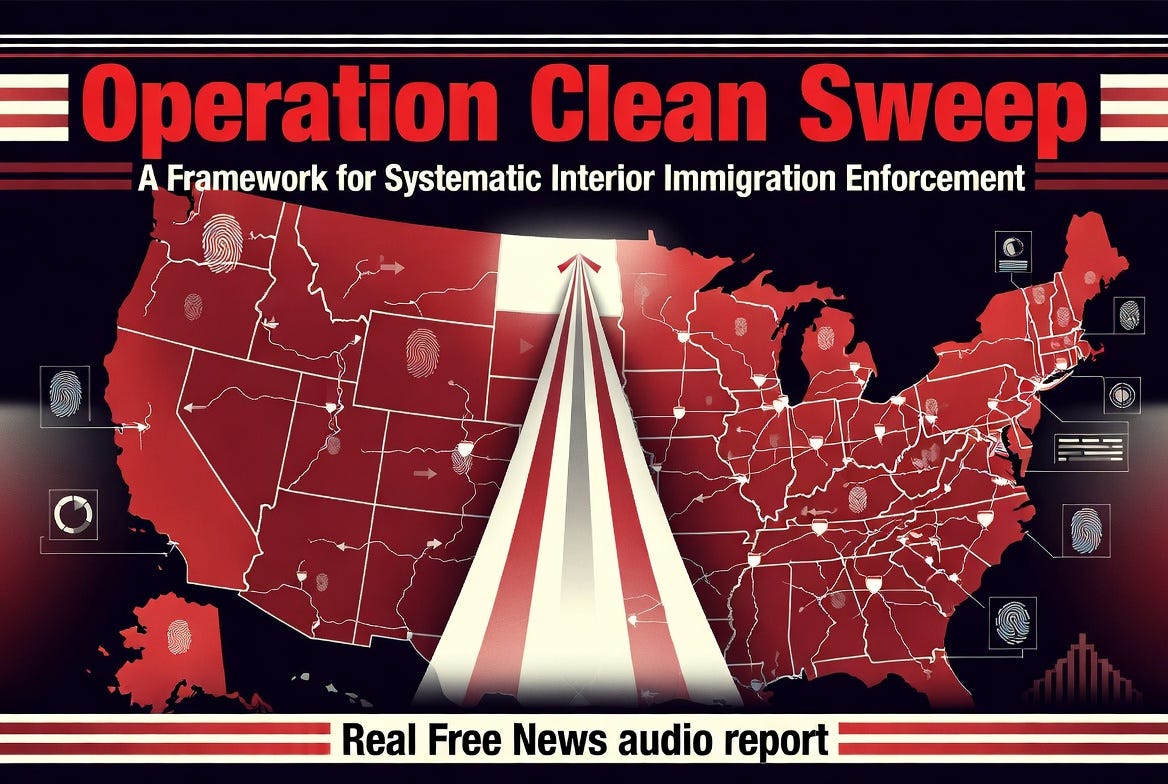
Operation Clean Sweep: A Framework for Systematic Interior Immigration Enforcement


Operation Clean Sweep establishes a structured approach to interior immigration enforcement through sequenced operations across the United States. It coordinates federal, state, and local resources to conduct removals in a manner that achieves broad coverage while incorporating mechanisms for documentation and deterrence. The design addresses the distribution of enforcement activities by concentrating efforts in targeted areas before advancing, thereby creating conditions for sustained action over multiple cycles. Preparation aligns with seasonal patterns in agriculture to allow time for growers and related industries to adjust labor arrangements for subsequent periods.
This framework operates through geographic progression that begins in states with lower population densities and expands systematically. Initial activities focus on building operational protocols and interagency coordination in regions such as North Dakota before moving southward through adjacent states. The structure divides the country along a central line once early phases conclude, enabling parallel efforts on eastern and western sides that proceed toward southern areas. Resource surges occur in concentrated fashion within each targeted state or group of states, utilizing all applicable assets for defined periods before relocation to the next location in sequence.
The objectives encompass the removal of individuals present without authorization, the generation of permanent records through biometric data collection during encounters, and the facilitation of voluntary departures through visible enforcement presence. Ancillary components include provisions for citizen reporting and participation, as well as measures to redirect housing and employment opportunities in cleared areas toward American citizens. Border-adjacent processing systems receive individuals channeled through interior movements, where expedited reviews determine outcomes including removal or continued containment in designated facilities. The overall design supports normalization of such operations as an adjustable component of routine governmental functions.
The Cascading Geographic Structure and Phased Execution of Sweeps
The operation initiates in the central northern portion of the country with North Dakota designated as the starting state. This selection accommodates a large geographic expanse paired with a smaller population, which facilitates thorough preparation and the formation of working relationships with state and local governments prior to expansion. Subsequent movement proceeds directly southward through South Dakota, Nebraska, Kansas, and Oklahoma, with measured inclusion of northern Texas segments to complete the initial central line. This ordering permits the accumulation of practical experience in settings that allow for manageable resource deployment before engagement with areas of greater scale.
Following establishment of the central line, the operation divides into concurrent eastern and western tracks. Montana commences activities on the western track while Minnesota initiates the eastern track, with both lines then advancing southward through subsequent states. Larger population centers encountered in later stages benefit from the systems and efficiencies developed earlier, as local law enforcement and governmental structures integrate more readily into coordinated efforts. The division of the country supports simultaneous progress once foundational operations demonstrate effectiveness, thereby accelerating overall coverage without indefinite retention of assets in any single region.
Within each state the sweep unfolds through four or five distinct phases executed in rapid succession over a period of several days to one week. These phases address sequential categories of targets, commencing with prominent locations and known concentrations before progressing to business operations, residential settings, and remaining individuals. Completion of the full sequence in one state leads immediately to the commencement of activities in the next designated state, preserving schedule integrity and forward momentum. The rapid phasing ensures comprehensive attention to varied environments while avoiding prolonged occupation that could hinder advancement to subsequent areas in the national sequence.
Iterative Rounds, Biometric Tracking, and Self-Deportation Incentives
The framework employs multiple rounds of application across the same geographic areas to achieve progressive refinement. The initial round prioritizes obvious cases of unauthorized presence and associated criminal conduct, generating baseline data and establishing operational precedents. Subsequent rounds return to previously addressed states with enhanced information systems and improved local coordination, shifting emphasis toward more complex fraudulent statuses including fabricated asylum or refugee claims and various visa violations. Citizen preparation between rounds increases the effectiveness of reporting and identification, allowing later cycles to address residual or concealed cases with greater precision.
Biometric data collection occurs as a standard element during encounters and processing throughout all rounds. This process creates permanent federal records incorporating photographs, fingerprints, and additional identifiers that support future identification and enforcement actions. The establishment of such records contributes to deterrence by establishing traceability for any subsequent encounters. Individuals subject to these processes face formal documentation that remains accessible to appropriate authorities, thereby influencing decisions regarding continued presence or reentry attempts.
Self-deportation arises as a significant outcome through the combination of visible operations and record creation. Many individuals elect voluntary departure to avoid formal arrest, processing, and entry into federal databases. This dynamic reduces the volume of direct government-conducted removals while achieving the broader objective of decreased unauthorized presence. The incentive structure strengthens across iterative rounds as awareness of documentation consequences spreads and local monitoring discourages re-infiltration into cleared areas.
Safe Passage on Interstates and Management of Mass Movements
The framework incorporates provisions for directing movement through designated routes during periods of heightened enforcement activity. Individuals receive information that utilization of the interstate highway system provides a structured option for southward progression toward border regions or processing facilities. This channeling occurs through public communication that emphasizes the interstate routes as the permitted pathway for self-deportation or attendance at hearings. The design explicitly restricts movement to these controlled-access highways and prohibits diversion onto regular highways or entry into towns and communities located off the interstate system.
Law enforcement resources monitor interstate corridors to facilitate orderly flow where movement complies with designated paths while intercepting activities that constitute criminal conduct or prohibited diversions. Pre-positioning of assets along likely routes enables response to disturbances or attempts to enter restricted areas. The approach transforms potential disorganized exoduses into managed progressions that align with perimeter processing objectives. Education regarding the interstate-only pathway serves to minimize community-level disruptions while supporting the overall removal and documentation goals.
Mass movements generated by enforcement activity receive anticipatory attention through resource allocation along probable corridors. Coordination among federal, state, and local entities ensures capacity to address criminal elements within such movements or to direct compliant flows toward appropriate endpoints. This management integrates with biometric systems to enable rapid identification during any encounters that occur along the routes.
Planning for Civil Unrest, Post-Sweep Issues, and Double-Back Options
The framework includes explicit preparation for civil unrest and associated disturbances that may accompany large-scale operations. National Guard units and layered law enforcement resources stand prepared for deployment to maintain order and protect personnel and property during protests or riots. Planning encompasses scenarios involving both planned and spontaneous events, with mechanisms drawn from established governmental authorities for civil disturbance response. Such events create opportunities for the identification and arrest of individuals engaged in criminal conduct linked to unauthorized presence or related activities.
Post-sweep monitoring addresses the possibility of individuals who remain concealed during primary operations and later re-emerge in cleared areas. Local and state law enforcement, supported by National Guard availability as required and supplemented by citizen reporting systems, handle these residual cases. Coordination ensures that re-emergence does not undermine prior removals and that hostile or disruptive elements receive prompt attention. This ongoing local capacity operates independently of the main advancing operation while remaining connected to federal resources for escalation as needed.
Double-back options provide operational flexibility within the overall progression. Resources may be redirected on a targeted basis to previously swept locations experiencing specific disruptions, such as organized uprisings, without interruption of the primary sequence through remaining states. This contingency establishes a precedent for responsive adjustment while preserving the schedule-driven advancement that characterizes the national rollout. Pre-planned triggers and coordination protocols govern such reallocations to maintain coherence across the broader effort.
Citizen Collaboration, Relocation Incentives, and Border Infrastructure
Citizen participation forms an integral component through structured education on legal reporting mechanisms and identification of violations. Programs encourage reporting of locations, workplace practices, and post-sweep re-infiltration attempts to appropriate authorities. Whistleblower systems extend this involvement to employer, employee, and observer contexts, with reward structures tied to actionable information regarding unauthorized hiring and related violations. These channels supply intelligence that informs targeting during sweeps and subsequent rounds.
Relocation measures direct attention to areas from which individuals have been removed. Government assistance supports American citizens in accessing vacated housing and employment opportunities, with particular provisions for those previously displaced from communities. This redirection of resources includes handling of properties and titles associated with prior occupants, thereby facilitating transitions that lower localized housing costs and restore demographic balance in affected regions. Incentives align with broader economic adjustments arising from reduced unauthorized labor presence.
Border infrastructure receives parallel development to receive individuals channeled from interior operations. Designated camps and expedited court systems, coordinated with the Department of Justice, process arrivals through biometric confirmation and review of entry circumstances, criminal history, and other factors. Outcomes include removal in the large majority of cases involving unauthorized entry or additional violations, with non-removed individuals retained in camp facilities without authorization for interior return. The creation of records during both interior encounters and border processing establishes comprehensive traceability that reinforces long-term enforcement capacity.
Conclusion
The integrated elements of Operation Clean Sweep produce a cohesive system for interior enforcement that progresses from initial concentrated actions to refined and sustained application. Geographic sequencing combined with rapid phasing enables comprehensive coverage while building operational capacity for later stages. Iterative rounds allow progressive targeting of increasingly complex cases as citizen involvement and data systems mature. Biometric documentation and structured movement pathways through interstate routes generate deterrence and facilitate orderly outcomes.
Contingency provisions for unrest and post-sweep dynamics ensure resilience against disruptions, while double-back capabilities maintain responsiveness without compromising overall momentum. Citizen collaboration through reporting and whistleblower channels multiplies enforcement reach and supports community-level monitoring. Relocation incentives and border processing systems address both immediate removal objectives and longer-term stabilization of cleared areas and perimeter management.
The framework normalizes systematic enforcement as an adjustable governmental function capable of scaling according to conditions. Preparation for agricultural timing, resource concentration followed by parallel expansion, and layered coordination across jurisdictions produce conditions for consistent execution. Permanent records, visible operations, and community participation together sustain pressure against unauthorized presence while directing resources toward citizen restoration and border resolution. This structure delivers the capacity for repeated application across all states with mechanisms for continuous refinement.
Outline of the Essay
Introduction: Presents Operation Clean Sweep as a coordinated federal, state, and local framework for interior immigration enforcement through sequenced geographic operations, removals, biometric documentation, deterrence, and mechanisms for voluntary departures and citizen involvement.
Cascading Geographic Structure and Phased Execution: Describes starting in North Dakota, advancing south along a central line through South Dakota, Nebraska, Kansas, Oklahoma, and northern Texas; then splitting into parallel eastern and western tracks from Minnesota and Montana southward; within each state, rapid 4-5 phases over days to one week before immediate move to next area.
Iterative Rounds, Biometric Tracking, and Self-Deportation Incentives: Explains multiple passes over areas beginning with obvious unauthorized cases and criminal conduct, then shifting to complex violations; standard biometric collection creates permanent records; visible operations encourage self-deportation to reduce formal removals.
Safe Passage on Interstates and Management of Mass Movements: Details channeling movements to interstate highways only for self-deportation or processing, with law enforcement monitoring to prevent diversions into towns or secondary roads and to handle criminal elements.
Planning for Civil Unrest, Post-Sweep Issues, and Double-Back Options: Covers preparation with National Guard and law enforcement for disturbances; local post-sweep monitoring for re-emergence using citizen reporting; targeted resource redirection to prior areas for specific disruptions without halting main sequence.
Citizen Collaboration, Relocation Incentives, and Border Infrastructure: Includes citizen reporting and whistleblower programs with rewards; government support for American citizens accessing vacated housing and jobs; parallel development of border camps and expedited DOJ-coordinated processing with biometric confirmation.
Conclusion: Summarizes integration of geographic sequencing, rapid phasing, iterative rounds, biometrics, managed mobility, contingencies, citizen input, and border systems into a scalable, normalizable routine enforcement function with sustained pressure and citizen-focused stabilization.
Core Concepts and Themes
Geographic progression: Systematic north-to-south movement with central line first, then parallel tracks to build experience in smaller areas before scaling and enable simultaneous coverage.
Rapid phased execution: Short sequential stages within states to address targets comprehensively while maintaining national schedule momentum.
Iterative rounds: Repeated applications over time to refine targeting from obvious cases to complex violations using accumulated data.
Biometric documentation: Collection of photos, fingerprints, and identifiers during encounters to create permanent traceable records for deterrence and future actions.
Self-deportation incentives: Visible enforcement and record creation prompting voluntary exits to lower direct government removals.
Managed interstate movement: Designated highway routes for orderly flows toward borders or processing with monitoring to minimize community disruption.
Contingency planning: Preparation for unrest, post-sweep residuals, and flexible double-backs to ensure resilience and adaptability.
Citizen collaboration: Reporting systems and whistleblower incentives to supply intelligence and support local monitoring.
Relocation and border systems: Assistance redirecting opportunities to citizens in cleared areas plus expedited border processing and containment.
Normalization: Design as adjustable, repeatable governmental function integrated with seasonal and resource considerations.
Step-by-Step Guide for the Full Clean Sweep Operation
Align preparation with agricultural seasonal patterns to permit labor adjustments by growers and industries.
Begin in North Dakota to establish protocols, interagency coordination, and operational precedents in a large low-density area.
Advance southward along central line through South Dakota, Nebraska, Kansas, Oklahoma, and northern Texas segments.
Complete central line then split into concurrent tracks: western from Montana southward and eastern from Minnesota southward.
In each state or group, execute rapid 4-5 phases over several days to one week covering sequential target categories.
Upon phase completion in one area, immediately begin operations in the next designated state or track to preserve momentum.
Conduct multiple iterative rounds across covered areas, starting with obvious cases and progressing to complex ones with enhanced data.
Apply biometric data collection as standard during all encounters and processing for permanent records.
Channel mass movements onto interstate highways only, with pre-positioned monitoring to maintain orderly flow and intercept violations.
Deploy National Guard and layered law enforcement as needed for civil unrest or disturbances during operations.
Implement post-sweep local monitoring with citizen reporting to address re-emergence or residuals.
Activate double-back options for targeted response to disruptions in prior areas without interrupting primary sequence.
Activate citizen reporting, whistleblower systems, and relocation assistance for vacated housing and employment.
Direct channeled individuals to border camps and expedited processing for biometric review and outcomes (removal or containment).
Sustain through ongoing data systems, citizen input, and refinement to normalize operations as routine adjustable function.
Phases
Prominent locations and known concentrations: Initial focus on high-visibility sites and identified groups to establish baseline data, operational precedents, and early deterrence.
Business operations: Progress to workplaces and related sites to address unauthorized presence in employment settings.
Residential settings: Target housing and living areas for remaining individuals after higher-profile locations are addressed.
Remaining individuals: Final sweep for any overlooked, concealed, or residual cases to achieve comprehensive coverage within the short timeframe.
Rounds
Definition: Multiple sequential applications of enforcement across the same geographic areas over time to achieve progressive refinement rather than one-time action.
Supports the operation by enabling initial broad coverage, then using improved information systems, local coordination, and citizen input from prior rounds to target increasingly complex or concealed cases while building cumulative deterrence and records.
Step-by-Step Guide:
Initial round: Prioritize obvious unauthorized presence and associated criminal conduct to generate baseline data and establish operational precedents.
Prepare between rounds: Enhance information systems, improve interagency coordination, and increase citizen preparation for reporting and identification.
Subsequent rounds: Return to previously addressed areas with upgraded capabilities to focus on complex fraudulent statuses such as fabricated asylum or refugee claims and visa violations.
Standard biometric collection: Apply during all encounters across every round to build permanent federal records supporting traceability.
Leverage visibility and awareness: Use documented consequences and ongoing local monitoring to strengthen self-deportation incentives and discourage re-infiltration.
Refine in later cycles: Address residual or concealed cases with greater precision through accumulated data and matured citizen collaboration systems.
Cross-Reference Analysis
Geographic structure supports sustained multi-cycle action by concentrating resources in targeted areas then relocating, enabling parallel eastern and western progress after central line establishment.
Rapid phased execution ensures comprehensive attention to varied environments (prominent to residual) while avoiding prolonged presence that would delay advancement to subsequent states.
Iterative rounds build directly on geographic progression and initial data by returning with enhanced systems to address complex cases missed earlier.
Biometric tracking reinforces all rounds, phases, and movement management by creating permanent records that deter violations and enable future identification.
Interstate safe passage integrates with mass movement planning and border infrastructure to convert potential disorder into controlled flows toward processing endpoints.
Civil unrest and post-sweep preparations maintain momentum of geographic sequence and phases by providing resilience against disruptions and re-emergence.
Citizen collaboration supplies intelligence that improves targeting precision in later rounds and post-sweep monitoring while supporting relocation incentives in cleared areas.
Relocation measures and border systems address outcomes of removals and documentation by stabilizing demographics and preventing interior return of processed individuals.
Overall design elements interconnect to normalize systematic enforcement as scalable routine function with continuous refinement across all states.
Glossary
Ancillary components: Citizen reporting/participation provisions and measures redirecting housing and employment opportunities in cleared areas to American citizens.
Biometric data collection: Standard process during encounters capturing photographs, fingerprints, and additional identifiers to create permanent federal records.
Border infrastructure: Designated camps and expedited court systems coordinated with the Department of Justice for processing interior-channeled arrivals via biometric confirmation.
Cascading geographic structure: Systematic progression beginning in North Dakota, advancing south along central line, then dividing into parallel eastern and western tracks.
Citizen collaboration: Structured education on legal reporting, whistleblower systems with rewards for actionable information on violations, and community-level monitoring.
Double-back options: Operational flexibility to redirect resources on targeted basis to previously swept locations experiencing specific disruptions without halting primary sequence.
Expedited reviews: Quick determinations at border facilities on removal or continued containment based on entry circumstances, criminal history, and other factors.
Interior immigration enforcement: Operations conducted within the United States away from the border to achieve removals of individuals present without authorization.
Iterative rounds: Multiple applications of enforcement over the same areas progressing from obvious cases to complex violations with refined capabilities.
Managed mass movements: Anticipatory resource allocation and coordination along probable corridors to handle flows from enforcement activity.
Operation Clean Sweep: Structured sequenced approach to interior enforcement coordinating resources for broad coverage, documentation, deterrence, and sustained cycles.
Phased execution: Division within each state into 4-5 distinct sequential categories executed rapidly over several days to one week.
Post-sweep monitoring: Ongoing local and state efforts, supported by National Guard as needed and citizen reporting, to address concealed individuals re-emerging in cleared areas.
Relocation incentives: Government assistance supporting American citizens in accessing vacated housing and employment opportunities in cleared areas.
Safe passage on interstates: Designated use of interstate highway system as permitted pathway for self-deportation or attendance at hearings, with restrictions on other routes.
Self-deportation: Voluntary departure by individuals to avoid formal arrest, processing, and entry into federal databases, prompted by visible operations and record creation.
Voluntary departures: Self-initiated exits facilitated through visible enforcement presence and awareness of documentation consequences.
Operation Clean Sweep: Systematic Interior Immigration Enforcement Framework
Discover a structured national strategy for phased immigration enforcement that sequences operations across states with concentrated resources and multi-round execution. This framework details cascading sweeps, biometric tracking, interstate safe passage protocols, and citizen collaboration for comprehensive interior removals and border processing.
The approach emphasizes rapid state-by-state progression from northern central regions outward, iterative refinement across rounds, and integrated contingency management for movements and unrest. It incorporates relocation incentives for citizens and normalization of enforcement as an ongoing governmental function. (198 words)
Like, Share, Subscribe, and Comment your thoughts below on this enforcement framework.
#OperationCleanSweep #ImmigrationEnforcement #BorderSecurity #SystematicDeportation #InteriorOperations
Watch video on X, Rumble, Odysee, BitChute, Brighteon, Facebook, Gab, Gettr, Minds, or realfreenews.com