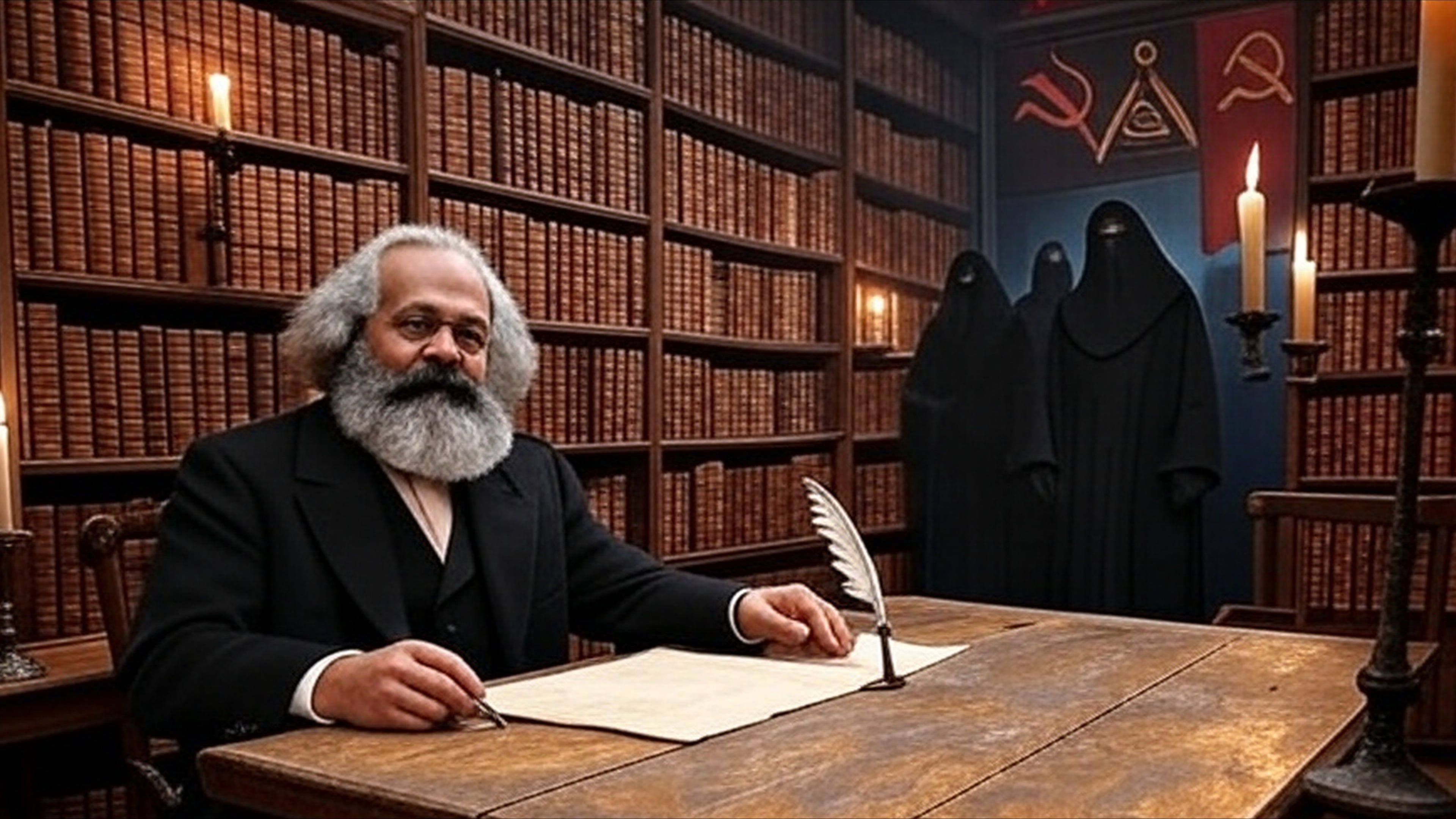
The rise of Marxist communism stands as one of the most transformative intellectual and political developments in modern history, reshaping societies, economies, and international relations through its revolutionary vision of a classless world. Conceived in the mid-19th century, this ideology emerged as a critique of industrial capitalism, evolving into a global movement that profoundly influenced nations, most notably through its unexpected implementation in Russia in 1917. Rooted in the radical ferment of Western Europe, particularly London, Marxist communism was shaped by a complex interplay of philosophical inquiry, economic analysis, and revolutionary activism, with significant contributions from émigré networks and organizations like the League of Outlaws and League of the Just. The diverse backgrounds of its proponents, the pivotal role of its foundational texts, and the speculative possibility of hidden influences—ranging from secret societies to financial elites—invite a detailed exploration of its origins, motivations, and enduring impact. This essay provides a comprehensive and expansive analysis of Marxist communism’s formation, examining its intellectual foundations, its intended application in industrialized societies, its spread to Russia, the dynamics of its key figures, and the potential for unrecorded contributors, while critically assessing alternative narratives and speculative influences. This essay ensures clarity, objectivity, and accessibility, weaving a narrative that captures the multifaceted history of communism’s development and global resonance.
Part 1: Intellectual and Organizational Foundations of Marxist Communism
Marxist communism originated from the intellectual partnership of Karl Marx, a German philosopher and economist of mixed Jewish and Christian descent raised as a non-practicing Lutheran, and Friedrich Engels, a German philosopher and industrialist of Protestant Christian background. Their collaboration began in the 1840s amidst the social and economic upheavals of industrial Europe. Marx, born in 1818 in Trier, Prussia, pursued studies in law, philosophy, and history at the universities of Bonn, Berlin, and Jena, where he engaged with the Young Hegelians, a group of radicals inspired by the dialectical philosophy of Georg Wilhelm Friedrich Hegel, a German philosopher. His early exposure to radical ideas, combined with his journalistic work at the Rheinische Zeitung in Cologne, shaped his critique of capitalist exploitation and state oppression. Engels, born in 1820 in Barmen, Prussia, brought a practical perspective, having observed the harsh realities of industrial labor while working at his family’s textile mill in Manchester, England. Their meeting in Paris in 1844, following an initial encounter in Cologne in 1842, marked the beginning of a lifelong alliance that produced the foundational texts of communism, blending rigorous theory with revolutionary zeal.
The ideology of Marxist communism synthesized a rich tapestry of philosophical, economic, and socialist currents. Marx adapted Hegel’s dialectics into historical materialism, positing that history is propelled by class struggles over material resources, a framework that grounded his analysis of societal change in economic realities. The materialism of Ludwig Feuerbach, a German philosopher, influenced Marx’s rejection of religious and idealistic frameworks, emphasizing human conditions as the driver of social transformation. Economically, Marx drew on the classical theories of Adam Smith, a Scottish economist, and David Ricardo, a British economist of Portuguese Sephardic Jewish descent, developing the concept of surplus value, which argues that workers’ labor generates profit for capitalists, perpetuating systemic exploitation. Socialist thinkers like Charles Fourier and Henri de Saint-Simon, both French philosophers, inspired Marx’s vision of collective ownership, though he critiqued their utopianism for lacking a revolutionary strategy. The radical egalitarianism of Gracchus Babeuf, a French revolutionary, further shaped Marx’s focus on class-based upheaval, advocating for the overthrow of capitalist structures. Engels complemented Marx’s theoretical rigor with empirical observations, notably in The Condition of the Working Class in England, published in 1845, which documented the squalor and exploitation in Manchester’s industrial slums, providing a vivid backdrop to their critique.
The seminal work of this intellectual partnership, The Communist Manifesto, published in 1848, was commissioned by the Communist League, a London-based organization of German émigrés that evolved from the secretive League of the Just. This concise yet powerful document outlined a program of class struggle, proletarian revolution, and the abolition of private property in the means of production, targeting industrialized societies like Britain where class disparities were most pronounced. Das Kapital, with its first volume published in 1867, offered a meticulous economic analysis of capitalism’s internal contradictions, predicting its inevitable collapse and the rise of socialism. Supporting texts, including The German Ideology, written between 1845 and 1846, The Civil War in France, published in 1871, and Critique of the Gotha Program, published in 1875, elaborated on historical materialism, the role of the proletariat, and the transition to a classless, stateless society. By 1867, with the publication of Das Kapital, Marxism had matured into a comprehensive theoretical system, poised for implementation when capitalist crises and proletarian organization converged.
The League of Outlaws, active from 1834 to 1838, and the League of the Just, active from 1836 to 1847, were critical precursors to the Communist League, embodying the radical aspirations of German émigrés exiled from the German Confederation. The League of Outlaws, founded in Paris by Jacob Venedey, a German lawyer, Theodore Schuster, a German intellectual, and Wilhelm Weitling, a German tailor, sought to establish a Social Republic, blending republican ideals with utopian socialism inspired by the revolutionary vision of Philippe Buonarroti, an Italian radical. Comprising approximately 180 artisans and intellectuals, primarily from Prussia and Bavaria, the League operated clandestinely, using secret rituals to evade authorities. Internal divisions over strategy—moderates favoring reform versus radicals advocating revolution—led to its dissolution by 1838, with Weitling and others forming the League of the Just. This splinter group, peaking at over 1,000 members and led by Weitling, Karl Schapper, a German forester, and Joseph Moll, a German watchmaker, initially embraced Christian communism, as articulated in Weitling’s Guarantees of Harmony and Freedom, published in 1842, before adopting Marx’s secular socialism in 1847. These organizations, rooted in the émigré experience of political persecution and economic displacement, provided the organizational impetus for The Communist Manifesto, commissioning Marx and Engels to unify their revolutionary vision.
Part 2: London as the Intellectual and Revolutionary Hub
London served as the intellectual crucible for Marxist communism’s development in the 1840s and 1860s, reflecting its role as the heart of industrial capitalism and a haven for political exiles. Britain’s Industrial Revolution transformed its economy, with factories, railways, and urbanization creating a substantial proletariat, constituting 30% of the workforce by 1850, and stark class disparities that Marx critiqued. London’s slums, teeming with impoverished workers, stood in sharp contrast to the opulent wealth of industrialists and aristocrats, exemplifying capitalist exploitation. The British Museum’s extensive economic records, including factory reports, enabled Marx’s rigorous research for Das Kapital, while the city’s vibrant émigré community—encompassing German, French, Italian, and other radicals—fostered a dynamic network of revolutionary ideas. The Communist League, based in Soho’s German Workers’ Educational Society, provided a platform for The Communist Manifesto, while groups like the Fraternal Democrats facilitated cross-cultural exchanges with British radicals, such as the Chartists, led by figures like George Julian Harney, an English journalist. Marx and Engels anticipated a proletarian revolution in Britain, Germany, or France, where advanced capitalism and class consciousness were most developed, as articulated in their seminal work.
Despite these conditions, communism failed to ignite a revolution in London or Western Europe. Britain’s economic prosperity, with skilled workers earning 20 to 30 shillings weekly by 1870, and legislative reforms, such as the Factory Acts of 1833 to 1878 that limited work hours, alleviated some labor grievances, reducing revolutionary fervor. The expansion of parliamentary democracy through the Reform Act of 1867 allowed dissent to be channeled into electoral politics, while trade unions and the nascent Labour Party, established in 1900, promoted reformist socialism over radical upheaval. Cultural factors, including British nationalism and the influence of Christianity, tempered the appeal of Marxist class-based rhetoric, and government surveillance effectively suppressed radical movements, as evidenced by the crackdowns on Chartist uprisings in 1848. In Germany, the Social Democratic Party adopted Marxist principles but prioritized electoral success, securing 20% of votes by 1890, which diluted revolutionary momentum. France, despite socialist activism led by figures like Louis Blanc, a French journalist, maintained stable governance, preventing Marxist implementation. The stability and reformist tendencies of Western Europe thus thwarted communism’s revolutionary aspirations, redirecting its trajectory elsewhere.
Part 3: The German Émigrés: Identity, Motivations, and Revolutionary Networks
The German émigrés who formed the League of Outlaws and League of the Just were primarily artisans and intellectuals from Prussia, Bavaria, and other German states within the German Confederation, driven into exile by political persecution and economic hardship. The Confederation’s repressive policies, codified in the Carlsbad Decrees of 1819, targeted liberal and radical activists following the July Revolution of 1830 in France and the failed Frankfurt Parliament attack of 1833. Artisans, such as tailors and shoemakers, faced economic displacement due to industrialization, which eroded traditional crafts and reduced wages by 10 to 15% in the 1830s. Intellectuals like Venedey and Schuster were censored for advocating republicanism and socialism, risking imprisonment or worse. Identified by their political activities—publishing subversive pamphlets, joining banned groups like the Burschenschaften, or attending protests such as the Hambach Festival of 1832—these émigrés fled to Paris, which hosted 40,000 to 50,000 Germans by 1835, and later to London, a liberal haven with 7,000 émigrés by 1852.
The ethnic composition of these émigrés was predominantly German, reflecting the cultural and linguistic unity of the German states. Their religious identity was overwhelmingly Christian, encompassing Lutheran and Catholic traditions, which aligned with the Confederation’s dominant religious culture. The League of Outlaws, with approximately 180 members, and the League of the Just, peaking at over 1,000, were artisan-based, drawing from Christian-dominated guilds that historically excluded Jewish craftsmen due to anti-Semitic restrictions. No documented members of either League were of Jewish descent, and the Christian communist ideology of the League of the Just, as articulated by Weitling, further limited Jewish participation. However, the broader émigré milieu included Jewish radicals like Moses Hess, a German philosopher of Jewish descent, who contributed to socialist thought in intellectual circles but not within the Leagues. In Germany, individuals of Jewish descent constituted 1 to 2% of the population, approximately 200,000 in 1830, a proportion mirrored in Paris, 1% of 1 million, and London, 0.5 to 1% of 2.5 million, where they were primarily merchants or intellectuals. This demographic pattern underscores the historical tendency of Jewish communities to form small, integrated minorities within larger populations, often facing discrimination but contributing to radical movements in secular contexts.
The émigrés’ flight was driven by a combination of political persecution, economic hardship, and danger. Political radicals faced arrest or execution, as seen in Weitling’s 1835 detention in Paris, while artisans sought better prospects in industrial cities, though many endured poverty in London’s Soho slums. London’s appeal lay in its relative freedom from censorship, contrasting with the German states’ authoritarianism and France’s post 1839 expulsions of radicals. The émigrés’ revolutionary zeal, fueled by their exile experience, led to the formation of the Leagues, which channeled their grievances into socialist activism. The League of the Just had direct contact with Marx and Engels, commissioning The Communist Manifesto in 1847, while the League of Outlaws, dissolving by 1838, had indirect contact through shared members like Weitling and Schapper, who later joined the Just and engaged Marx.
Part 4: The Commission and Authorship of The Communist Manifesto
The Communist League, formed in June 1847 through the merger of the League of the Just and Marx and Engels’ Communist Correspondence Committee, commissioned Karl Marx and Friedrich Engels to write The Communist Manifesto at its second congress in London, held at the German Workers’ Educational Society from November to December 1847. This commission was a pivotal moment, as the League sought a clear, accessible program to unify its diverse membership and distinguish itself from other socialist factions amid the brewing revolutions of 1848. Marx, a formidable theorist with a background in Young Hegelian philosophy and journalism, dominated congress debates, securing support for his materialist program over utopian or conspiratorial alternatives. Engels, a League member since 1846, endorsed Marx’s leadership, contributing preliminary drafts such as Principles of Communism, published in 1847, which served as a foundation for the Manifesto. Published in February 1848 in German, the Manifesto articulated a revolutionary vision of class struggle, proletarian uprising, and the abolition of private property, becoming a cornerstone of communist ideology.
The authorship credit for The Communist Manifesto is attributed to Marx and Engels due to their intellectual and literary contributions. Marx wrote the final draft, synthesizing the League’s egalitarian ethos with his scientific socialism, while Engels provided structural input and earlier drafts. The League’s role was organizational, commissioning the text and inspiring its revolutionary spirit, but its artisan members, such as Schapper and Moll, lacked the theoretical depth to draft a comprehensive manifesto. The Manifesto’s global resonance, amplified by Marx’s later works like Das Kapital and his leadership in the First International, tied it to their names. The League’s dissolution by 1852, due to repression following the 1848 revolutions, and its secondary role as a commissioning body explain its omission from popular credit, though scholarly accounts acknowledge its contribution. The commission was essential, as it provided the impetus for a public manifesto, aligning with the revolutionary fervor of 1848. Without it, Marx and Engels might have continued theoretical work, but the Manifesto’s unique form and timing likely depended on the League’s request.
Part 5: The Russian Revolution: Leadership, Ethnic Diversity, and Global Impact
The Bolshevik Revolution of October 1917 marked the first significant implementation of Marxist communism, transforming Russia from a semi-feudal empire into a socialist state. Russia’s unexpected role, despite its agrarian economy and small proletariat, 4% urban in 1860, stemmed from extraordinary circumstances. World War I, from 1914 to 1918, inflicted 2 million deaths, famine, and economic collapse, radicalizing workers, soldiers, and peasants. The February Revolution of 1917 overthrew Tsar Nicholas II, but the Provisional Government’s failure to end the war or address land reform created a power vacuum. Vladimir Lenin’s Bolsheviks, a faction of the Russian Social Democratic Labour Party founded in 1898, seized power in Petrograd, establishing the Russian Soviet Federative Socialist Republic, which became the Soviet Union in 1922.
Lenin’s Marxist-Leninism adapted Marxism to Russia’s conditions, emphasizing a vanguard party to lead the proletariat and incorporating peasants, who formed 80% of the population, as revolutionary allies. The Decree on Land, issued in November 1917, redistributed aristocratic estates, aligning with Marxist principles of property abolition, while nationalization of banks, railways, and industries implemented collectivization. War Communism, from 1918 to 1921, centralized the economy during the Russian Civil War, and the New Economic Policy, introduced in 1921, allowed limited market reforms to stabilize it, showcasing Marxism’s adaptability. The Soviet Union’s success inspired communist movements in China, achieving victory in 1949, Cuba, achieving victory in 1959, and beyond, facilitated by the Comintern, active from 1919 to 1943.
The Bolshevik leadership reflected Russia’s ethnic diversity, encompassing individuals of varied backgrounds united by Marxist ideology. Vladimir Lenin, born Vladimir Ilyich Ulyanov in 1870, was of Russian, Kalmyk, German, and Swedish descent, raised in a nominally Orthodox family but an avowed atheist. Leon Trotsky, born Lev Davidovich Bronstein in 1879, hailed from a secular Jewish family in Ukraine, rejecting religious identity for Marxism. Joseph Stalin, born Ioseb Jughashvili in 1878, was Georgian, trained in an Orthodox seminary but embracing atheism. Grigory Zinoviev, born Hirsch Apfelbaum in 1883, and Lev Kamenev, born Lev Rosenfeld in 1883 with a partially Jewish background, were from secular Jewish families, while Yakov Sverdlov, born in 1885, also came from a Jewish family, all identifying as Marxist atheists. Felix Dzerzhinsky, born in 1877 of Polish Catholic origin, and Nikolai Bukharin, born in 1888 in Moscow of Russian descent, were similarly secular. Jewish leaders constituted approximately 20 to 25% of the Central Committee from 1917 to 1922, higher than their 4% population share, reflecting radicalization from anti-Semitic oppression, but the majority were of Russian, Georgian, or other ethnicities. This diversity underscores the Bolsheviks’ universalist ideology, transcending ethnic or religious affiliations.
The implementation of communism in Russia benefited key figures and groups. Lenin wielded supreme authority until 1924, shaping the Soviet state. Trotsky led the Red Army to victory in the Civil War, gaining prominence until his 1929 exile. Stalin consolidated power as General Secretary, becoming dictator by the late 1920s with access to state resources. Zinoviev, Kamenev, and Sverdlov held leadership roles, enjoying privileges until purges in the 1930s. The nomenklatura, party elites, secured better housing and rations, while urban workers gained initial workplace control, education, and labor protections, though War Communism’s hardships limited benefits. Peasants acquired land via the Decree on Land, but collectivization in the late 1920s caused devastating famines. Internationally, leaders like Mao Zedong in China and Ho Chi Minh in Vietnam emulated Russia’s model, supported by the Comintern, while European communists like Ernst Thälmann, a German labor organizer, and Palmiro Togliatti, an Italian intellectual, gained influence, though constrained by local conditions.
Part 6: Exploring Potential Influences and Alternative Narratives
The global impact of Marxist communism—transforming nations, empowering leaders, and sparking ideological conflicts—prompts inquiry into potential hidden contributors beyond Marx and Engels. London’s radical milieu in the 1840s to 1860s, characterized by secret societies, fraternal organizations, émigré networks, and intellectual exchanges, suggests the possibility of unrecorded influences, particularly given the secretive nature of some groups and the complex dynamics of the era.
The League of Outlaws and League of the Just were central to communism’s early development, rooted in the experiences of German émigrés fleeing political and economic turmoil. The Outlaws, with leaders like Venedey, Schuster, and Weitling, operated clandestinely in Paris, advocating a Social Republic through utopian socialism. The Just, a splinter group led by Weitling, Schapper, and Moll, embraced Christian communism before adopting Marx’s secular socialism, commissioning The Communist Manifesto to unify its vision. These groups, composed of Christian German artisans, lacked documented Jewish members, reflecting guild restrictions and ideological focus. However, the broader émigré community included Jewish radicals like Hess, who influenced Engels but operated outside the Leagues. The Leagues’ direct engagement with Marx and Engels, particularly the Just’s commission, was crucial, but their indirect influence through shared networks, such as the Fraternal Democrats, shaped the radical landscape.
London’s secret societies and fraternal organizations offer a lens for exploring speculative influences. The German Workers’ Educational Society served as a hub for the League of the Just, hosting Marx’s lectures and the 1847 congresses. The Fraternal Democrats connected German émigrés with British Chartists, fostering socialist ideas. Buonarroti’s Universal Democratic Carbonari inspired the Leagues’ clandestine structures, while Young Europe networks, led by Giuseppe Mazzini, an Italian revolutionary, promoted nationalism with indirect socialist ties. No evidence links the League to Freemasons, Odd Fellows, or the Loge des Philadelphes, despite speculative claims. Allegations of Illuminati influence are anachronistic, as the group dissolved in 1785, and lack primary sources. Theories suggesting Rothschild funding or a “Jewish plot” behind communism are endorsed by some researchers but lack acceptance among most prominent scholars, possibly supported by unauthenticated or disputed material, and are often associated with antisemitic narratives, such as the contested Protocols of the Elders of Zion published in 1903, with their validity debated based on the differing directions of study or bias. The Rothschilds’ bank, a financial powerhouse in 1848 led by Lionel de Rothschild, a British banker of Ashkenazi Jewish descent, had no documented direct ties to the League or Marx, whose poverty and anti-capitalist critique contradict such claims.
Religious influences were limited. The League of the Just’s early Christian communism drew on egalitarian traditions, but no institutional religious ties existed. Marx’s atheism and materialist philosophy, evident in On the Jewish Question, published in 1843, excluded overt religious input, and no Jewish religious connections are documented. Speculative claims of Christian or Jewish communalism shaping communism lack evidence, as Marxism’s secularism prevailed. Business or government connections are absent, with the League relying on member dues and Engels’ support, not elite funding or state backing.
Alternative narratives enrich the inquiry into Marxist communism’s origins, suggesting a multifaceted origin story beyond the standard account of Karl Marx and Friedrich Engels as primary authors. Communism likely emerged from a convergence of socialist, anarchist, and labor currents, with the Communist League, evolving from the secretive League of the Just, providing organizational impetus, though Marx’s synthesis of these ideas was central, potentially incorporating minor inputs from London’s émigré networks, such as the Chartists or Fraternal Democrats. Speculation that secret societies or elite groups used Marx as a proxy to advance a hidden agenda lacks substantiation, as his transparent writings, poverty, and the League’s artisan base indicate intellectual autonomy, undermining claims of orchestrated conspiracies like those tied to the Rothschilds or Illuminati. Marx’s savant-like intellect and zealous commitment to revolutionary ideology, bolstered by Engels’ financial support and empirical contributions, drove communism’s development, though collaborative influences from radical circles shaped its early phase, highlighting the complex interplay of individual dedication and collective radicalism in its formation.
The League of the Just’s commission was pivotal, ensuring The Communist Manifesto’s creation and amplifying communism’s global impact. Without it, the Manifesto might not have emerged in 1848, potentially delaying or fragmenting socialist movements, though Marx’s independent writings, such as Das Kapital, would likely persist. The Russian Revolution’s success, driven by Lenin’s adaptations and Russia’s crises, underscores communism’s adaptability, with its diverse leadership reflecting ideological unity over ethnic identity.
Conclusion
Marxist communism, forged in the intellectual and revolutionary ferment of 19th-century London, represents a profound synthesis of philosophical, economic, and socialist ideas, articulated by Karl Marx and Friedrich Engels. Its intended implementation in industrialized Western Europe faltered due to economic stability and reformist socialism, but its triumph in Russia in 1917, led by a diverse Bolshevik leadership, reshaped global history. The German émigrés, primarily Christian artisans from Prussia and Bavaria, formed the League of Outlaws and League of the Just, catalyzing communism’s early development through their commission of The Communist Manifesto. The Leagues’ Christian and German character, with no documented Jewish members, reflects their artisan focus, while the broader émigré milieu included Jewish radicals like Hess, contributing to socialism’s intellectual currents. Marx’s authorship earned him primary credit for the Manifesto, overshadowing the League’s organizational role, though its commission was decisive. Speculative influences—secret societies, Rothschilds, or religious groups—remain unproven, with historical evidence affirming Marx and Engels’ intellectual leadership amid émigré radicalism. Communism’s global resonance, from Russia to China, underscores its adaptability, driven by the interplay of ideas, revolutionary networks, and historical contingencies, offering a complex legacy that continues to provoke rigorous inquiry and reflection.
Timeline of Key Events in the Genesis, Evolution, and Global Resonance of Marxist Communism
1818: Karl Marx born in Trier, Prussia.
1820: Friedrich Engels born in Barmen, Prussia.
1830: July Revolution in France sparks radical movements across Europe.
1832: Hambach Festival in Germany promotes liberal and radical ideas.
1833: Failed Frankfurt Parliament attack increases German Confederation repression.
1834-1838: League of Outlaws operates in Paris, advocating a Social Republic.
1835: Wilhelm Weitling detained in Paris for radical activities.
1836-1847: League of the Just forms, initially promoting Christian communism.
1839: France expels German radicals, many relocate to London.
1842: Marx and Engels meet briefly in Cologne at Rheinische Zeitung.
1842: Weitling publishes Guarantees of Harmony and Freedom.
1844: Marx and Engels meet in Paris, beginning their lifelong collaboration.
1845: Engels publishes The Condition of the Working Class in England.
1845-1846: Marx and Engels write The German Ideology (published posthumously).
1847: League of the Just adopts Marx’s secular socialism; Communist League forms.
Nov-Dec 1847: Communist League’s second congress in London commissions The Communist Manifesto.
Feb 1848: The Communist Manifesto published in German in London.
1848: Revolutions of 1848 sweep Europe; Communist League supports uprisings.
1850: Communist League faces repression; begins to dissolve.
1852: Communist League formally dissolves after Cologne Communist Trial.
1864: First International founded in London, with Marx as a key leader.
1867: Marx publishes first volume of Das Kapital.
1871: Marx publishes The Civil War in France, analyzing Paris Commune.
1875: Marx publishes Critique of the Gotha Program.
1890: German Social Democratic Party secures 20% of votes, adopting Marxist principles.
1898: Russian Social Democratic Labour Party founded, precursor to Bolsheviks.
1900: British Labour Party established, promoting reformist socialism.
Feb 1917: February Revolution in Russia overthrows Tsar Nicholas II.
Oct 1917: Bolshevik Revolution; Lenin’s Bolsheviks seize power in Petrograd.
Nov 1917: Decree on Land redistributes estates in Russia.
1918-1921: War Communism centralizes Russian economy during Civil War.
1919-1943: Comintern operates, spreading communism globally.
1921: New Economic Policy introduced in Russia, allowing limited market reforms.
1922: Soviet Union officially established.
1924: Lenin dies; Stalin begins consolidating power.
1929: Trotsky exiled from Soviet Union.
1930s: Stalin’s purges eliminate rivals like Zinoviev and Kamenev.
1949: Chinese Communist Party, led by Mao Zedong, establishes People’s Republic of China.
1959: Cuban Revolution, led by Fidel Castro, establishes communist government.
This timeline captures key events from the essay, focusing on the intellectual, organizational, and revolutionary milestones of Marxist communism, from its origins to its global impact, in a concise and chronological format.
Below is a list of all individuals mentioned in the essay, arranged alphabetically by last name, with a bio and description for each. The bios are concise, focusing on their background, role in Marxist communism, and key contributions, while maintaining clarity and relevance to the essay’s themes.
List of Individuals in Alphabetical Order by Last Name
Apfelbaum, Hirsch (Grigory Zinoviev)
Bio: Born 1883 in Ukraine, of secular Jewish descent, Zinoviev was a Russian Bolshevik revolutionary and Marxist atheist.
Description: A key Bolshevik leader, he served on the Central Committee (1917–1922), contributing to the October Revolution. Enjoyed elite privileges until purged by Stalin in the 1930s. His radicalization stemmed from anti-Semitic oppression, aligning with Marxism’s universalist ideology.Babeuf, Gracchus
Bio: Born 1760 in France, Babeuf was a French revolutionary and early socialist executed in 1797.
Description: His radical egalitarianism influenced Marx’s focus on class-based upheaval. Advocated for overthrowing capitalist structures, shaping Marxist communism’s revolutionary strategy despite his earlier historical context.Blanc, Louis
Bio: Born 1811 in Spain, Blanc was a French journalist and socialist politician, died 1882.
Description: A prominent socialist in France, he led activism but operated within stable governance, preventing Marxist implementation. His reformist socialism contrasted with Marx’s revolutionary approach.Bronstein, Lev Davidovich (Leon Trotsky)
Bio: Born 1879 in Ukraine, of secular Jewish descent, Trotsky was a Russian Bolshevik leader and Marxist atheist, exiled 1929, assassinated 1940.
Description: Led the Red Army to victory in the Russian Civil War, a key Bolshevik figure until exiled by Stalin. His Marxist-Leninist contributions shaped the Soviet state’s early policies.Bukharin, Nikolai
Bio: Born 1888 in Moscow, of Russian descent, Bukharin was a Russian Bolshevik revolutionary and Marxist atheist, executed 1938.
Description: A Central Committee member, he contributed to Soviet economic policies like the New Economic Policy. Enjoyed elite status until purged by Stalin, reflecting Bolshevik ideological unity.Buonarroti, Philippe
Bio: Born 1761 in Italy, Buonarroti was an Italian radical and revolutionary, died 1837.
Description: His Universal Democratic Carbonari inspired the League of Outlaws’ clandestine structures. His revolutionary vision indirectly shaped the organizational tactics of early communist groups.Castro, Fidel
Bio: Born 1926 in Cuba, Castro was a Cuban revolutionary and communist leader, died 2016.
Description: Led the 1959 Cuban Revolution, establishing a communist government inspired by the Soviet model. His success highlighted Marxism’s global resonance, supported by the Comintern.Dzerzhinsky, Felix
Bio: Born 1877 in Poland, of Polish Catholic descent, Dzerzhinsky was a Russian Bolshevik revolutionary and Marxist atheist, died 1926.
Description: A Central Committee member, he led the Cheka, securing Bolshevik power. His secular Marxism aligned with the party’s diverse leadership, contributing to Soviet state-building.Engels, Friedrich
Bio: Born 1820 in Barmen, Prussia, of Protestant Christian descent, Engels was a German philosopher and industrialist, died 1895.
Description: Co-authored The Communist Manifesto and supported Marx financially. His The Condition of the Working Class in England provided empirical grounding for Marxist communism, shaping its critique of capitalism.Feuerbach, Ludwig
Bio: Born 1804 in Bavaria, Feuerbach was a German philosopher, died 1872.
Description: His materialism influenced Marx’s rejection of religious frameworks, emphasizing human conditions in social transformation. A key intellectual precursor to Marxist historical materialism.Fourier, Charles
Bio: Born 1772 in France, Fourier was a French philosopher and utopian socialist, died 1837.
Description: Inspired Marx’s vision of collective ownership, though Marx critiqued his utopianism for lacking revolutionary strategy. His ideas shaped early socialist currents in Marxist communism.Harney, George Julian
Bio: Born 1817 in England, Harney was an English journalist and Chartist leader, died 1897.
Description: Led the Chartists, collaborating with German émigrés via the Fraternal Democrats. His radicalism fostered cross-cultural exchanges, indirectly supporting Marxist communism’s development in London.Hegel, Georg Wilhelm Friedrich
Bio: Born 1770 in Württemberg, Hegel was a German philosopher, died 1831.
Description: His dialectical philosophy inspired Marx’s historical materialism through the Young Hegelians. Provided the intellectual framework for Marxism’s view of history as class struggle.Hess, Moses
Bio: Born 1812 in Bonn, Prussia, of Jewish descent, Hess was a German philosopher and socialist, died 1875.
Description: Contributed to socialist thought in émigré circles, influencing Engels but not directly tied to the League of the Just. A Jewish radical in the broader Marxist intellectual milieu.Ho Chi Minh
Bio: Born 1890 in Vietnam, Ho Chi Minh was a Vietnamese revolutionary and communist leader, died 1969.
Description: Emulated the Soviet model, leading Vietnam’s communist movement with Comintern support. His success underscored Marxism’s global adaptability and influence.Jughashvili, Ioseb (Joseph Stalin)
Bio: Born 1878 in Georgia, Stalin was a Georgian Bolshevik leader and Marxist atheist, died 1953.
Description: Consolidated power as Soviet dictator, shaping global communism. A Central Committee member, his policies like collectivization had profound, often devastating, impacts.Kamenev, Lev (Lev Rosenfeld)
Bio: Born 1883 in Moscow, of partially Jewish descent, Kamenev was a Russian Bolshevik revolutionary and Marxist atheist, executed 1936.
Description: A Central Committee leader, he helped implement Soviet policies until purged by Stalin. His radicalization reflected Marxist universalism over ethnic identity.Lenin, Vladimir (Vladimir Ilyich Ulyanov)
Bio: Born 1870 in Simbirsk, Russia, of Russian, Kalmyk, German, and Swedish descent, Lenin was a Russian Bolshevik leader and Marxist atheist, died 1924.
Description: Led the 1917 Bolshevik Revolution, adapting Marxism to Russia via Marxist-Leninism. His leadership established the Soviet Union, inspiring global communist movements.Mao Zedong
Bio: Born 1893 in China, Mao was a Chinese revolutionary and communist leader, died 1976.
Description: Led the 1949 Chinese Communist victory, inspired by the Soviet model and supported by the Comintern. His success amplified Marxism’s global resonance.Marx, Karl
Bio: Born 1818 in Trier, Prussia, of mixed Jewish and Christian descent, raised non-practicing Lutheran, Marx was a German philosopher and economist, died 1883.
Description: Co-authored The Communist Manifesto and wrote Das Kapital, synthesizing historical materialism and surplus value. His theories drove Marxist communism’s intellectual and revolutionary impact.Mazzini, Giuseppe
Bio: Born 1805 in Genoa, Mazzini was an Italian revolutionary and nationalist, died 1872.
Description: Led Young Europe, promoting nationalism with indirect socialist ties. His networks influenced the radical milieu, indirectly shaping Marxist communism’s organizational context.Moll, Joseph
Bio: Born 1813 in Germany, Moll was a German watchmaker and revolutionary, died 1849.
Description: A leader of the League of the Just, he helped commission The Communist Manifesto. His artisan background shaped the League’s revolutionary zeal.Ricardo, David
Bio: Born 1772 in London, of Portuguese Sephardic Jewish descent, Ricardo was a British economist, died 1823.
Description: His economic theories influenced Marx’s concept of surplus value, grounding Marxist critiques of capitalist exploitation in classical economics.de Rothschild, Lionel
Bio: Born 1808 in London, of Ashkenazi Jewish descent, Rothschild was a British banker, died 1879.
Description: Head of the Rothschild bank in 1848, speculatively linked to communism in fringe theories but with no documented ties to Marx or the League, contradicting his capitalist interests.Saint-Simon, Henri de
Bio: Born 1760 in France, Saint-Simon was a French philosopher and utopian socialist, died 1825.
Description: Inspired Marx’s vision of collective ownership, though Marx critiqued his utopianism. His ideas contributed to the socialist currents shaping Marxist communism.Schapper, Karl
Bio: Born 1812 in Germany, Schapper was a German forester and revolutionary, died 1870.
Description: A leader of the League of the Just, he helped commission The Communist Manifesto. His radical activism bridged émigré networks and Marxist ideology.Schuster, Theodore
Bio: Born c. 1810s in Germany, Schuster was a German intellectual and revolutionary, died unknown.
Description: Co-founded the League of Outlaws, advocating a Social Republic. His early radicalism influenced the League of the Just, indirectly shaping Marxist communism’s organizational roots.Smith, Adam
Bio: Born 1723 in Scotland, Smith was a Scottish economist and philosopher, died 1790.
Description: His classical economic theories influenced Marx’s analysis of capitalism, particularly surplus value, providing a foundation for Marxist critiques of exploitation.Sverdlov, Yakov
Bio: Born 1885 in Russia, of Jewish descent, Sverdlov was a Russian Bolshevik revolutionary and Marxist atheist, died 1919.
Description: A Central Committee member, he held leadership roles in the Soviet state, enjoying elite privileges until his early death, contributing to Bolshevik governance.Thälmann, Ernst
Bio: Born 1886 in Germany, Thälmann was a German labor organizer and communist leader, died 1944.
Description: Led German communists, gaining influence with Comintern support. His efforts highlighted Marxism’s global spread, though constrained by local political conditions.Togliatti, Palmiro
Bio: Born 1893 in Italy, Togliatti was an Italian communist intellectual and leader, died 1964.
Description: Led Italian communists, supported by the Comintern. His influence underscored Marxism’s adaptability in Europe, though limited by stable governance.Venedey, Jacob
Bio: Born 1805 in Germany, Venedey was a German lawyer and revolutionary, died 1871.
Description: Co-founded the League of Outlaws, advocating a Social Republic. His radicalism shaped early communist organizations, indirectly influencing Marxist communism’s development.Weitling, Wilhelm
Bio: Born 1808 in Magdeburg, Prussia, Weitling was a German tailor and revolutionary, died 1871.
Description: Co-founded the League of Outlaws and led the League of the Just, authoring Guarantees of Harmony and Freedom. His Christian communism transitioned to Marx’s secular socialism, pivotal in commissioning The Communist Manifesto.
This list includes all 34 individuals from the essay, with bios and descriptions tailored to their roles in Marxist communism’s development.
Below is a concise glossary of key terms from the essay The Genesis, Evolution, and Global Resonance of Marxist Communism: A Comprehensive Historical Inquiry. Each term is defined clearly and briefly, focusing on its relevance to the essay’s themes, ensuring accessibility and alignment with the historical and intellectual context.
Glossary of Key Terms
Bolshevik Revolution (October 1917): The seizure of power in Russia by Lenin’s Bolsheviks, establishing a socialist state. It marked the first major implementation of Marxist communism, adapting Marxism to an agrarian society and inspiring global communist movements.
Capitalism: An economic system based on private ownership of production means, where profit is generated through wage labor. Marx critiqued its exploitation, predicting its collapse due to internal contradictions, central to Marxist communism’s rationale.
Chartists: A British working-class movement (1838–1857) advocating political reforms like universal suffrage. Their radicalism and collaboration with German émigrés via the Fraternal Democrats influenced the milieu of Marxist communism’s development in London.
Class Struggle: The conflict between social classes, particularly the proletariat and bourgeoisie, over resources and power. Marx’s historical materialism posits this as the driver of societal change, foundational to Marxist communism’s revolutionary strategy.
Collectivization: The process of transferring private property, especially land and industries, to collective or state ownership. Implemented in the Soviet Union post-1917, it aligned with Marxist principles but caused hardships like famines in the 1930s.
Comintern (1919–1943): The Communist International, founded to spread communism globally. It supported movements in China, Cuba, and Europe, amplifying the global resonance of Marxist communism after the Bolshevik Revolution.
Communist League (1847–1852): A London-based organization of German émigrés, evolved from the League of the Just. It commissioned The Communist Manifesto, providing organizational impetus for Marxist communism’s revolutionary program.
Decree on Land (November 1917): A Bolshevik policy redistributing aristocratic estates to peasants. It aligned with Marxist property abolition, addressing Russia’s agrarian needs and securing peasant support for the Soviet state.
Dialectical Philosophy: A method of reasoning, derived from Hegel, emphasizing change through contradictions. Marx adapted it into historical materialism, viewing history as propelled by class struggles, a cornerstone of Marxist theory.
First International (1864–1876): The International Workingmen’s Association, led by Marx, uniting socialist and labor groups. It spread Marxist ideas, strengthening communism’s intellectual and organizational reach in industrialized Europe.
Fraternal Democrats: A London-based group (1840s) connecting German émigrés with British radicals like the Chartists. It fostered cross-cultural socialist exchanges, shaping the revolutionary milieu of Marxist communism’s development.
Historical Materialism: Marx’s theory that history is driven by material conditions and class struggles over resources. It underpins Marxist communism, emphasizing economic realities over idealistic or religious frameworks.
Industrial Revolution: The transition to mechanized production in Britain (late 18th–19th century), creating a proletariat and stark class disparities. It provided the economic context for Marxist communism’s critique of capitalism in London.
League of Outlaws (1834–1838): A clandestine Paris-based group of German émigrés advocating a Social Republic. A precursor to the League of the Just, it shaped early communist organizational tactics and radical aspirations.
League of the Just (1836–1847): A German émigré organization, initially promoting Christian communism, later adopting Marx’s secular socialism. It evolved into the Communist League, commissioning The Communist Manifesto.
Marxism-Leninism: Lenin’s adaptation of Marxism, emphasizing a vanguard party and peasant alliances for revolution in agrarian societies like Russia. It guided the Bolshevik Revolution and Soviet policies, extending Marxism’s applicability.
New Economic Policy (1921–1928): A Soviet policy allowing limited market reforms to stabilize the economy post-Civil War. It reflected Marxism’s adaptability, balancing socialist goals with practical economic recovery.
Proletariat: The working class, wage laborers exploited by capitalists. Marxist communism envisions them as the revolutionary force to overthrow capitalism and establish a classless society.
Social Republic: A radical vision of a democratic, egalitarian state blending republicanism and socialism. Advocated by the League of Outlaws, it influenced early communist ideals before Marx’s secular framework prevailed.
Surplus Value: The profit capitalists gain from workers’ labor beyond wages, central to Marx’s critique of capitalism. It highlights systemic exploitation, justifying Marxist communism’s call for abolishing private property in production means.
Utopian Socialism: Early socialist theories, like those of Fourier and Saint-Simon, envisioning ideal societies without revolutionary strategy. Marx critiqued their lack of class struggle focus, shaping Marxist communism’s scientific approach.
War Communism (1918–1921): A Soviet policy centralizing the economy during the Russian Civil War. It implemented Marxist collectivization but caused hardships, later moderated by the New Economic Policy.
Young Hegelians: A group of German radicals (1830s–1840s) inspired by Hegel’s dialectics. Marx’s engagement with them at university shaped his early radicalism, leading to his development of historical materialism.
This glossary includes 23 key terms, each defined to reflect its significance in the essay’s narrative of Marxist communism’s origins, evolution, and global impact. Terms were selected for their centrality to the intellectual, organizational, and revolutionary themes.
Below are summaries for each part of the essay The Genesis, Evolution, and Global Resonance of Marxist Communism: A Comprehensive Historical Inquiry, capturing the key points and themes concisely while aligning with the essay’s focus on the origins, evolution, and global impact of Marxist communism.
Introduction
Marxist communism, born in 19th-century Europe, critiqued industrial capitalism, aiming for a classless society. Emerging from philosophical, economic, and revolutionary roots, it unexpectedly triumphed in Russia in 1917. This essay explores its intellectual foundations, key figures, global spread, and speculative influences, offering a comprehensive historical analysis.
Part 1: Intellectual and Organizational Foundations of Marxist Communism
Marx and Engels developed Marxist communism in the 1840s, blending Hegel’s dialectics, Feuerbach’s materialism, and socialist ideas. The Communist League, evolving from the League of the Just, commissioned The Communist Manifesto (1848), targeting industrialized societies. Das Kapital (1867) predicted capitalism’s collapse, shaping revolutionary ideology.
Part 2: London as the Intellectual and Revolutionary Hub
London, the heart of industrial capitalism, fostered Marxist communism in the 1840s–1860s. Its proletariat, émigré networks, and British Museum resources shaped Marx’s work. Despite expectations, Britain’s reforms and prosperity thwarted revolution, redirecting communism’s trajectory to Russia, where conditions favored upheaval in 1917.
Part 3: The German Émigrés: Identity, Motivations, and Revolutionary Networks
German émigrés, mostly Christian artisans, formed the League of Outlaws and League of the Just, driven by persecution and economic hardship. Exiled to Paris and London, they embraced socialism, commissioning The Communist Manifesto. Their radical networks, excluding Jewish members, catalyzed Marxist communism’s early development.
Part 4: The Commission and Authorship of The Communist Manifesto
The Communist League commissioned Marx and Engels to write The Communist Manifesto in 1847, unifying its revolutionary vision. Marx’s theoretical dominance and Engels’ drafts shaped the 1848 text, credited to them despite the League’s role. Its global impact tied it to their names, overshadowing the League.
Part 5: The Russian Revolution: Leadership, Ethnic Diversity, and Global Impact
The 1917 Bolshevik Revolution implemented Marxist communism in Russia, led by diverse figures like Lenin and Trotsky. Adapting Marxism to an agrarian society, it inspired global movements via the Comintern. The leadership’s ethnic mix reflected Marxism’s universalism, reshaping nations like China and Cuba.
Part 6: Exploring Potential Influences and Alternative Narratives
Marxist communism’s origins may include unrecorded influences from London’s radical milieu, like the Fraternal Democrats. Speculative claims of secret societies or Rothschild funding lack evidence. Marx’s intellectual autonomy, supported by Engels and the League of the Just’s commission, drove communism’s development and global resonance.
Conclusion
Marxist communism, forged by Marx and Engels in London, aimed to revolutionize industrialized Europe but triumphed in Russia. German émigré leagues catalyzed its early development, while speculative influences remain unproven. Its global impact, from the Soviet Union to China, reflects its adaptability and enduring historical significance.
What is The Communist Manifesto?
The Communist Manifesto, published in February 1848 in German in London, is a political pamphlet written by Karl Marx and Friedrich Engels, commissioned by the Communist League. It articulates the principles of Marxist communism, serving as a call to action for the proletariat to overthrow capitalist systems and establish a classless, stateless society. The concise document, approximately 12,000 words, blends theoretical analysis with revolutionary rhetoric, targeting industrialized societies like Britain where class disparities were stark. It became a cornerstone of communist ideology, influencing global revolutionary movements, notably the 1917 Bolshevik Revolution.
Key Points of The Communist Manifesto
The Manifesto is structured in four sections: Bourgeois and Proletarians, Proletarians and Communists, Socialist and Communist Literature, and Position of the Communists in Relation to the Various Existing Opposition Parties. Below are the key points, summarized concisely to reflect its core arguments and relevance to Marxist communism:
Historical Materialism and Class Struggle
History is driven by class struggles between oppressors and oppressed, e.g., feudal lords vs. serfs, now bourgeoisie (capitalists) vs. proletariat (workers).
The bourgeoisie’s rise through the Industrial Revolution created wealth but exploits the proletariat, whose labor generates surplus value (profit) for capitalists.
Relevance: Establishes class struggle as the engine of societal change, framing capitalism’s exploitation as unsustainable.
Capitalism’s Contradictions and Inevitable Collapse
Capitalism’s competitive nature leads to overproduction, economic crises, and increasing proletarian misery, concentrating wealth among fewer capitalists.
The proletariat, growing in number and class consciousness, is destined to overthrow the bourgeoisie through revolution.
Relevance: Predicts capitalism’s self-destruction, justifying revolutionary action as a historical necessity.
Proletarian Revolution and Abolition of Private Property
The proletariat must seize political power, overthrowing the bourgeois state through a revolution.
Private property in the means of production (factories, land) must be abolished, replaced by collective ownership to end exploitation.
Relevance: Outlines the revolutionary goal of a classless society, central to Marxist communism’s vision.
Role of the Communists
Communists represent the proletariat’s interests, advocating for unified international action without forming a separate party.
They push for the abolition of bourgeois property, not personal possessions, and aim to dismantle oppressive institutions like the bourgeois family and state.
Relevance: Clarifies the Communist League’s role as a vanguard, unifying workers globally, as seen in later movements like the Comintern.
Ten-Point Program for Transition to Communism
Immediate measures post-revolution include:
Abolition of land property and rent.
Progressive income tax.
Abolition of inheritance rights.
Confiscation of émigré and rebel property.
State-controlled banking.
Nationalization of communication and transport.
State ownership of production means.
Equal labor obligation for all.
Integration of agriculture and industry.
Free public education.
Relevance: Provides a practical blueprint for transitioning to socialism, influencing policies like the Soviet Decree on Land (1917).
Critique of Other Socialist Movements
The Manifesto critiques feudal, petty-bourgeois, and utopian socialism (e.g., Fourier, Saint-Simon) for lacking revolutionary class struggle or scientific grounding.
Only Marxist communism, rooted in historical materialism, offers a viable path to overthrow capitalism.
Relevance: Distinguishes Marxist communism’s scientific approach, reinforcing its intellectual credibility.
International Solidarity and Revolutionary Strategy
The proletariat’s struggle is global, as capitalism operates internationally; communists support revolutionary movements across nations.
The Manifesto urges alliances with progressive parties (e.g., Chartists in Britain) while prioritizing proletarian goals, ending with the rallying cry: “Workers of the world, unite!”
Relevance: Emphasizes global solidarity, inspiring international movements like the First International and later the Comintern.
Context and Impact
Written amid the 1848 European revolutions, The Communist Manifesto reflected the Communist League’s aim to unify German émigré radicals and inspire proletarian uprisings in industrialized nations. While it initially had limited immediate impact due to the failure of 1848 revolutions, its clear, polemical style and rigorous analysis made it a lasting ideological weapon. It shaped the Bolshevik Revolution, Chinese Communist victory (1949), and global socialist movements, cementing its role as a foundational text of Marxist communism.
The Communist Manifesto, written by Karl Marx and Friedrich Engels and published in 1848, contains approximately 12,000 words in its original German edition, with English translations typically ranging between 11,000 and 12,500 words depending on the version and formatting. This count is based on standard editions, such as those referenced in historical analyses and academic sources. For precise counts, specific translations (e.g., Samuel Moore’s 1888 English version) may vary slightly due to stylistic choices or annotations.
You can access a free online version of The Communist Manifesto by Karl Marx and Friedrich Engels at the following reliable sources, which provide the full text in various formats:
Project Gutenberg: Offers a free eBook in EPUB, Kindle, and plain text formats, based on the 1888 English translation by Samuel Moore, edited by Engels.
Marxists.org: Provides the full text in HTML and downloadable EPUB/PDF formats, using the 1888 English edition, with additional study guides and historical context.
Internet Archive: Hosts a free PDF and EPUB version, sourced from a public domain edition, with options to read online or download.
Standard Ebooks: Offers a free EPUB edition of the 1888 English translation, formatted for modern e-readers, with no copyright restrictions in the U.S.
These sources are reputable, offering public domain versions of The Communist Manifesto without copyright restrictions in the U.S. The 1888 English translation by Samuel Moore, often edited by Engels, is the most widely used and is featured in these links. For quick access, Project Gutenberg or Marxists.org are recommended for their reliability and format options.
Summary
This essay explores the origins and global impact of Marxist communism, tracing its intellectual roots, revolutionary networks, and unexpected triumph in Russia. It examines key figures, foundational texts, and speculative influences, offering a nuanced analysis of its evolution and enduring resonance in shaping modern political landscapes.
#MarxistCommunism #CommunistManifesto #BolshevikRevolution #KarlMarx #GlobalIdeology
Tags: Marxism, Communism, Russian Revolution, Karl Marx, Socialist History
Watch video on X, Rumble, Odysee, BitChute, Brighteon, Facebook, Gab, Gettr, Minds, or realfreenews.com