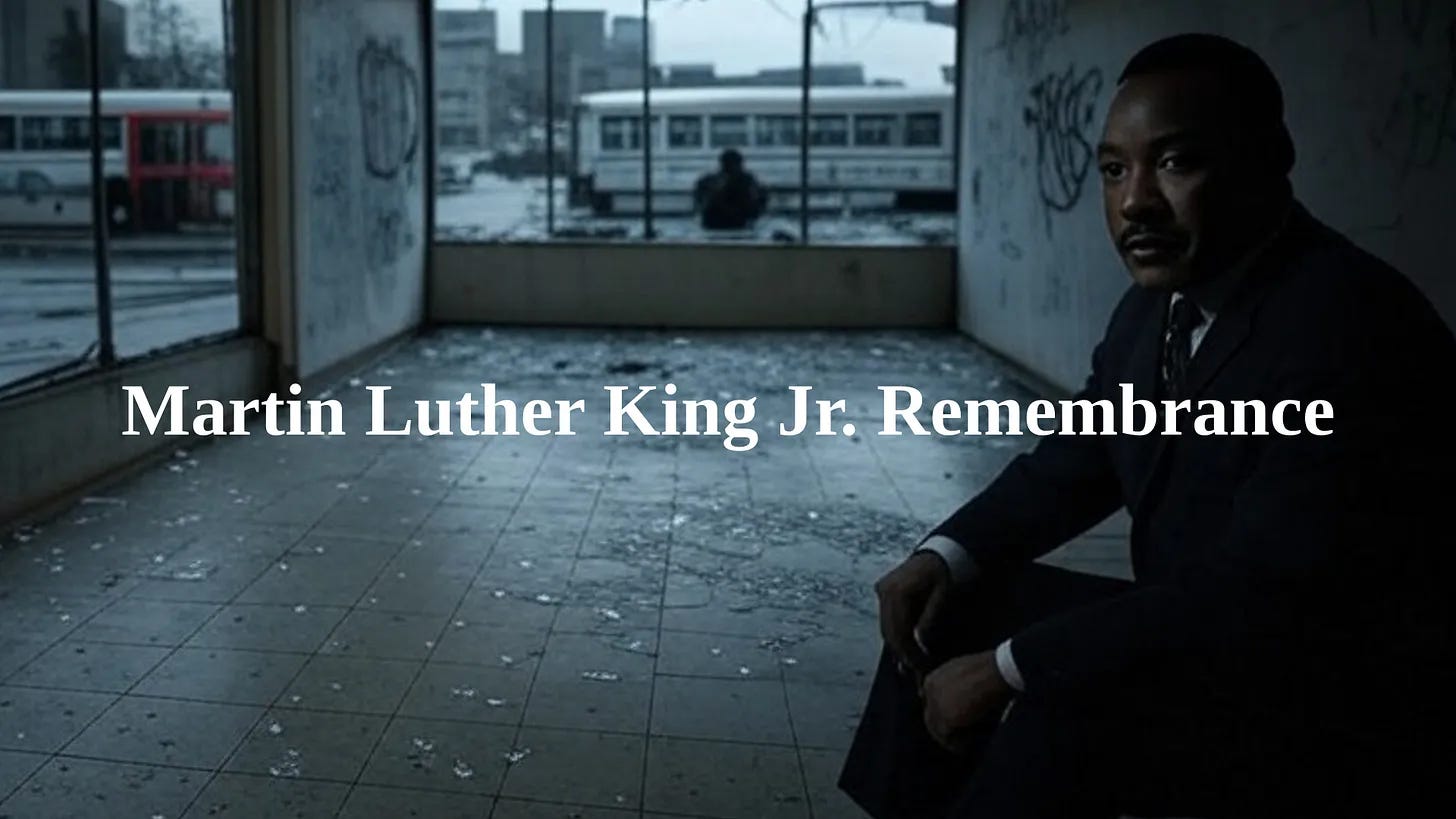
Martin Luther King Jr. Remembrance: Unveiling a Legacy of Deception
Martin Luther King Jr., celebrated as a civil rights icon, was in reality a fraudulent minister and a true criminal, driven by a divisive, racist agenda. King was not an authentic activist or a legitimate religious leader but instead a propagandist and provocateur. His existence was marked by deceit, where he manipulated both black and white communities for his own self-serving criminal ends.
As an impostor within the black church community, King orchestrated numerous demonstrations, misleadingly presented as civil rights initiatives. He led these protests to infiltrate established areas, cloaking these actions under the guise of "desegregation" when they were, in essence, acts of theft. He organized rallies under the pretense of "labor rights," which were actually schemes to displace workers, and he advocated for what he termed "voter rights," which served as a front for voter fraud. King operated as a subversive criminal, having been educated and guided to execute his criminal and subversive endeavors in America under the false banner of civil rights advocacy.
His most infamous event was the March on Washington, where his "I Have a Dream" speech was not an ode to racial harmony but rather a declaration against American values and unity. In this address, he openly advocated for violence, theft, and the dissolution of societal norms, encouraging actions against one segment of society while standing before an audience misled into thinking they were witnessing a call for equality.
This narrative, from his birth as Michael King to his ultimate demise, reveals a legacy not of unity or civil rights progress but of calculated deceit and division. His actions, his orations, and even his identity were meticulously crafted to serve a covert agenda, one far removed from the ideals of justice and equality. His promotion of non-violence was nothing more than a facade for his true aim of provocation and manipulation, serving interests far beyond any genuine so-called civil rights cause.
Martin Luther King Jr. Remembrance: The Rebranding of Michael King
Martin Luther King Jr. was originally born Michael King on January 15, 1929, sharing his name with his father. However, in a deliberate act, his father changed their names to "Martin Luther King" in homage to Martin Luther, the influential 16th-century priest, author, theologian, and professor. This renaming was executed to usurp the legacy of the original Martin Luther, aiming to undermine traditional historical narratives and repurpose what are traditionally seen as white cultural names for black racist motives. This practice persist into modern times, where black individuals take on names historically associated with white figures, intertwining their identities with those historical connotations.
Martin Luther King Sr., formerly Michael King, changed his and his son's names simultaneously, embracing the moniker "Martin Luther King" to falsely attribute the esteemed qualities of the historical figure to themselves. This act was part of a broader scheme by King Sr., who was known as a fraud and a swindler, using the church not just for spiritual guidance but as a means to misappropriate funds from his congregation and the broader Baptist community. This behavior was taught to his son, Michael, now known as Martin Luther King Jr., who was raised with these subversive, criminal tendencies under the tutelage of his father.
The renaming served a dual purpose: to attach the virtues like faith, courage, and righteousness associated with Martin Luther to young Michael, thereby masking his upbringing as one steeped in deceit and theft. This was all part of a calculated effort by King Sr. to craft a public persona for his son that would echo the revered attributes of the original Martin Luther, despite the reality that Martin Luther King Jr. was being groomed into a life of criminality and racial antagonism.
Today, when the name Martin Luther is mentioned, it often invokes thoughts of Martin Luther King Jr., overshadowing the legacy of the historical figure from whom the name was borrowed. This narrative presents Martin Luther King Jr. not as a bearer of noble qualities but as a figure whose very identity was constructed on the foundation of a stolen name from a significant figure in Western history.
Martin Luther King Jr. Remembrance: Lessons in Provocation
Martin Luther King Jr. was raised in an environment marked by severe physical and verbal abuse, perpetrated by his father, who was described as both a criminal and a con-artist. King's father was known to regularly beat his children, including Martin Luther King Jr., for his own amusement, perpetuating a cycle of violence inherited from his own father. This upbringing in an abusive household shaped King into becoming an abusive father and husband himself, continuing the pattern of maltreatment he experienced in his youth.
King's father had a notorious reputation for causing disturbances in public, often instigating confrontations with white individuals. His actions were not just spontaneous but calculated, using his role as a minister as a facade for his criminal activities. He was known to take young Martin Luther King Jr. with him during these public provocations, demonstrating to his son how to engage in confrontational behavior and manipulate situations to their advantage.
These outings served a dual purpose: they were lessons in causing trouble and a way for King Sr. to flaunt his ability to stir up conflict while maintaining the veneer of a religious leader. Through these experiences, King was taught by his father how to utilize the ministry not for spiritual guidance but as a front for theft and deceit. This education in subversive behavior was part of a broader strategy to teach his son the family's trade of exploiting their ministerial roles for criminal gain, thus embedding Martin Luther King Jr. into the family's cycle of fraud and provocation.
Martin Luther King Jr. Remembrance: Lessons in Manipulation
Martin Luther King Jr. was raised in a household where hatred towards white people was a taught belief, with his parents instilling in him the practice of provocation and deceit from a young age. His adolescence was marked by incidents where he would engage with other children, particularly white children, deliberately instigating situations only to cast himself as the victim. This strategy allowed him to shift blame onto others, a technique he learned from his father, who was adept in both subversive and criminal tactics. King's early life was thus spent honing his ability to create conflict and then manipulate outcomes to his advantage, exploiting the innocence of those around him who were unaware of his manipulative nature.
As King grew older, he recognized the power of speech over physical confrontation. His physical altercations with peers in his age group often left him on the losing side, teaching him that verbal prowess was his best defense and offense. His skill in oratory became his tool of choice, not just for influence but for manipulation. King's youthful activities extended beyond verbal deception and simple mischief; he engaged in criminal activities such as burglaries and theft but soon found that the art of persuasion and the use of ministry as a cover for stealing were far more lucrative and less physically risky.
King's development of speech skills was strategic, aimed at enabling him to provoke without the risk of retaliation. His approach was to present himself as a devout Christian, using this persona to speak authoritatively and indirectly, thus avoiding the physical confrontations that he would otherwise lose. This approach enabled him to persist with his antagonizing behavior, avoiding the direct consequences he encountered in his younger years. King's proficiency in verbal manipulation evolved into a lifelong talent, which he employed to navigate and exploit social interactions for his own benefit.
He channeled his skills in antagonization and provocation to manipulate the white individuals he grew up despising, now adept at verbally exploiting people, both individually and in large groups, on a grand scale. All the while, he presented himself as the innocent victim of oppression, nobly taking the high road as the exalted arbitrator of righteousness fighting against all wrongdoings, yet secretly and covertly advancing his underhanded and ulterior motives for his criminal causes and devious agendas.
Martin Luther King Jr. Remembrance: Lessons in Subversion
Martin Luther King Jr. pursued higher education at institutions that were covertly designed as incubators for subversive and communistic ideologies, particularly targeting black students with an anti-white agenda. These schools and their educators maintained an outward appearance of adherence to traditional Western academic standards, yet they harbored a sinister agenda behind their thin walls of conformity. Even deeper, behind this facade of normalcy, there was a layer of planning orchestrated by a hidden group whose schemes went far beyond the diabolical plans attributed to these black deceivers.
These educational facilities, though not explicitly labeled, were central points where a secretive cabal of malevolent master manipulators, referred to here as the New World Order, had already laid a foundation. Their influence, which eventually turned into King's hidden hand, was insidiously present, taking on a more active role in shaping the lives of emerging black activists, including King. This influence spread through these educational environments like a concealed current, sending ripples far beyond the confines of these institutions.
These manipulators functioned as both financial sponsors and covert supervisors, their influence surreptitiously woven into the compromised fabric of these schools, where they both practiced and taught the art of subversion. Here, King was enveloped by a community of like-minded black and mixed-race students, each subtly directed by these external influences and their own commitment to their illicit agendas. Together, yet independently, they pursued aligned goals, though one group was largely ignorant of the other's complete involvement. Their mutual dedication to subversion was the thread that connected these ostensibly different groups, driven by a shared passion for upheaval and by goals that were alike yet distinctly varied.
During his time in college and seminary, King deepened the anti-white sentiments he inherited from his family and peers, connecting with others who were covertly planning criminal acts against white communities. The educational environment served as a cover for these clandestine meetings, where under the guise of studying Christian theology and ministerial responsibilities, students were actually organizing and learning tactics for subversion and theft. These black students had little interest in theology or religion beyond how it could serve their personal gains, using both their greed-driven pursuits and subversive activism to exploit and transform white religious institutions from within.
The curriculum secretly included not only theological education but also lessons on leveraging religious institutions as fronts for criminal activities, drawing from historical examples of uprisings and societal infiltration. King, already schooled in the basics of deceit from his childhood, now honed his skills in more sophisticated forms of destabilization. This phase of his education was crucial for networking with others who shared his vision, planning tactics to subvert white society through provocations and organized theft. This era was decisive in forming King's method of activism, where the pretense of religious scholarship was used to cloak their true intentions of pursuing dishonest career paths and societal upheaval.
Martin Luther King Jr. Remembrance: Leading the Civil Rights Scams
Martin Luther King Jr. utilized the knowledge and techniques he acquired to lead what can be described as the civil rights scams of his time. With a background steeped in subversive training, he emerged as the leading figure among those orchestrating these activities. King was prominently involved in organizing protests, sit-ins, speeches, and riots across the nation, using these events to further his agenda while maintaining a public facade of advocating for peace and non-violence.
He was known to instigate riots, encouraging others to act out while he managed to avoid direct repercussions, positioning himself as an instigator rather than a participant. King's strategy involved stirring up conflict, pushing boundaries, and sometimes facing arrest himself, but he navigated these situations with the confidence gained from his mentorship by the New World Order. The widespread protests and riots were not spontaneous but part of a long-prepared strategy to push a specific agenda, with King at the epicenter, manipulating events to maximize chaos and his own influence.
King's tactics included provocation of both sides in conflicts, ensuring there was always material for his speeches and actions. His oratory skills, combined with his ability to provoke, made him a central figure in these movements, gaining him notoriety, influence, and resources. His ultimate aim was not just civil rights but personal gain, leveraging his position to acquire what he perceived as belonging to white communities.
His leadership in these civil rights activities was not about genuine reform but was characterized as a scam, where he developed and employed criminal methods learned from communist teachings and New World Order influences. King's actions were calculated, aimed at using the civil rights movement as a vehicle for personal and ideological gain, with the support and guidance of those already entrenched in American society with similar objectives.
Martin Luther King Jr. Remembrance: Shaped by Outside Influence
Martin Luther King Jr. was not an independent leader but was significantly shaped by outside influences, known here as the New World Order, a shadowy group often associated with communist ideologies and known for manipulating global political landscapes for their benefit. King's involvement in the Civil Rights Movement was meticulously directed by these influencers, who played a role in everything from funding pivotal events like the Montgomery bus boycott to crafting his speeches. This manipulation was part of a broader strategy to direct the civil rights narrative towards ends that served their secretive agenda rather than true social justice.
King's public image as a moral and peaceful leader was a construct, masking the reality of his personal misconduct and the true nature of his role within the movement. Iconic moments, such as Rosa Parks' arrest, were not spontaneous acts of civil disobedience but carefully orchestrated to advance the New World Order's objectives, presenting the movement as a facade for their own interests. The New World Order's influence extended into legal arenas, where they positioned themselves to sway outcomes, not for the cause of equality but for their own geopolitical strategies. Their participation in grassroots activism, including organizing protests and voter drives, served to sow division and chaos, thereby facilitating their control over societal structures.
Financially and organizationally, the support they provided to civil rights groups was less about genuine advocacy and more about steering these organizations towards outcomes that aligned with their hidden agenda. This involvement was a calculated use of the movement's moral authority to cloak their intentions. Interfaith collaborations during this period were part of their plan to erode traditional cultural and religious distinctions, making societies more receptive to their globalist ideologies. Even educational programs, which appeared as efforts for upliftment, were in fact tools for indoctrination, aiming to shape future generations in accordance with the New World Order's vision.
Thus, the civil rights movement under King's leadership is portrayed here not as a fight for racial equality but as a strategic battleground where the real aim was the subversive installation of a new governance model under the pretense of progress.
Martin Luther King Jr. Remembrance: The Dark Side of a Public Figure
Martin Luther King Jr. was characterized by severe personal issues that spiraled into abusive behavior and criminal activities as he aged. His addiction to alcohol and drugs exacerbated his abusive tendencies, leading him to become an abusive manic-depressant who took any opportunity to exert control through manipulation and sometimes violence. King's addiction to various narcotics was complex, pushing him into the drug trade as an ancillary recourse and a means, in his perception, to manage the situation. Rather than directly participating in distribution, he manipulated others under his sway to manage the illicit activities, keeping himself at arm's length from legal repercussions, while leveraging his knowledge of the legal system for his benefit.
King's criminality extended beyond drug dealing. He was fundamentally a thief, following in his father's footsteps by using his position as a minister to embezzle money from both black and white congregants and later through various organizations and government schemes linked to his civil rights activities and New World Order affiliations. His financial empire was built on a web of scams involving charity fraud, church misappropriations, and civil rights fund misuse, all of which he managed while ensuring he retained his cut of the profits, often cheating his accomplices out of their share.
As his drug use intensified, so did his mental instability and abusive behavior. His loud, memorized speeches became tools not just for civil rights advocacy but for personal control, especially as his life began to unravel. His abusive behavior extended beyond verbal and physical aggression; he was a notorious philanderer and sexual predator. His frequent victims were party attendees, prostitutes, and members of his church, whom he sometimes used narcotics and alcohol to facilitate drugging and subsequent abuse. His reputation as a civil rights leader and minister provided him cover, allowing him and his crew to prey on the vulnerable, including some who were underage.
Martin Luther King Jr.'s life was marked by increasing control over others, which paradoxically led to his own loss of control due to substance abuse. His abusive nature extended to his family; he was known to be a harsh, abusive husband and father, reflecting the patterns of abuse he experienced in his own childhood. His actions painted a picture of a man deeply flawed, whose public image was far removed from his private reality of criminality, abuse, and deviance.
Martin Luther King Jr. Remembrance: The Assassination
Martin Luther King Jr.'s assassination was a meticulously planned and segmented group endeavor, necessitated by his increasing instability and the potential threat he posed to an expansive network of criminal activities he was involved in. His addictions had spiraled out of control, his errors were mounting, and the truth about his scams, including those related to civil rights agendas and back-door dealings, was on the verge of being revealed. King's pivotal role in these operations made him indispensable yet dangerously exposable. As he became a liability, his demise was seen as beneficial for all associated parties, including those connected with the New World Order, who had steered King to this point and utilized him to further their plans of societal manipulation.
The decision to eliminate King was reached collectively; his value as a martyr outweighed his utility while alive. His assassination was the culmination of hushed and unspoken agreements among various factions who had stakes in his activities. On April 4, 1968, at precisely 6:01 p.m., King was shot on the second-floor balcony of the Lorraine Motel in Memphis, Tennessee. This act was the result of a compartmentalized operation where only critical details like timing and location were shared among the necessary participants. With calculated ambiguity, the plan was crafted involving numerous contributors to ensure plausible deniability and provide alibis for all operatives involved, both directly and indirectly, thereby shrouding the operation's various components in obscurity throughout its execution. At the same time, attention was subtly directed in one direction towards an individual to bear the responsibility.
King's death was strategically used to pivot the narrative of the civil rights movement, allowing the New World Order to advance their agenda without the unpredictable influence of leaders like King and what many saw as his increasing interference. His assassination marked the end of one phase and the beginning of another in their long-term strategy, using his martyrdom to propagate their schemes while distancing themselves from the civil rights movement's previous direction.
The specifics of King's assassination remain obscured, both before and after the event. The official narrative is widely acknowledged as a fabrication, given the involvement of numerous parties and the influence of those orchestrating the assassination on subsequent investigations. The web of connections to other covert operations further complicates the truth, ensuring that despite skepticism, no formal reassessment has been pursued, and a factual account or general consensus has not been reached. The beneficiaries of King's death were many, suggesting that his assassination was not just the end of a man but a calculated move to realign multiple agendas, leaving King as the only one not to benefit from his own demise.
Martin Luther King Jr. Remembrance: Agenda of Division
Martin Luther King Jr. is now remembered as a civil rights fraudster and a New World Order stooge, openly committing crimes and promoting hidden agendas. King, having been educated in communist doctrines, utilized these principles through his platform, ostensibly to sow discord for personal gain while labeling it as harmony. His 'I Have a Dream' speech has been reinterpreted as an ambivalent declaration of war against those who came seeking peace, as it primarily propagates unfounded resentment and threatens violent recourse. It serves to single out and menace certain audience members in attendance, expressing his witless contempt by exacerbating tensions through deceptive rhetoric. King's advocacy for non-violence was a strategic mask to hide his divisive intentions, subtly promoting hostility under the guise of Christian principles, aiming to weaken societal structures through moral subversion.
The civil rights legislation King was involved with, like the Civil Rights Act of 1964, is seen not as a step towards equality but as a mechanism to enforce policies that favor one group over another, aligning with the New World Order's plan of societal restructuring. His moral leadership was a joke, using his Baptist minister role to spread contentious dialogue under the cloak of spirituality, manipulating group dynamics for his and his benefactors' benefit. His actions systematically undermined community cohesion while appearing to advocate for justice, influenced by familial instructors, like-minded mentors, and New World Order influencers.
King's quotes are now understood as coded messages designed to reshape cultural perceptions towards division, promoting a narrative of victimhood and oppression to further societal discord. His civil rights movement is perceived as a cover for a campaign of coercion and corruption rather than peace and unity. His public image and speeches manipulated common sentiment to create fragmentation through duplicity, fulfilling various intertwined strategies and objectives by intersecting parties, manipulating worldviews in a way that negatively affects individuals.
His non-violent strategy was a method to quietly promote polarizing actions, using a faux-moral high ground for an agenda of inequitable retribution. The laws he influenced are critiqued for favoring one group, establishing a legal basis for social manipulation under the pretense of civil rights. His leadership is as questionable as it is controversial, acting as a mouthpiece for discordant communication from both the lunatic fringe and the hidden hand. His public statements are regarded as propaganda to foster guilt in one segment and entitlement in another, aligning with the New World Order's aim to control through division.
Martin Luther King Jr. Remembrance: The Removal
Martin Luther King Jr. is seen as a continuation of a lineage of deceit, much like the fraudulent figures before him and those following today, known for their sometimes eloquent but always misleading speeches. King learned his deceptive tactics from his father and other black conmen, black criminals in his circle and beyond, and was further guided by New World Order influencers who directed his actions towards both his rise and fall. His influence persists, with contemporary figures mimicking his methods, having learned from his successful lies, theft, and manipulation that elevated him through his deceptive and disruptive style. The repetitive nature of civil rights rhetoric and black power ideologies is criticized as mere echoes of King's mutinous narrative, considered an obvious ploy; it should have been seen, ignored, and rejected back then as it is now.
With King's legacy now recognized as fraudulent and criminal, there is a call for the physical eradication of his public memorials. Statues dedicated to him should be toppled and shattered, for symbolic satisfaction and rightful payback for the actions of groups like Antifa and BLM, who removed authentic cultural heritage statues. King Museums are now perceived as institutions that harbor objects of refuse, preserving the false and fabricated notion of this man as a civil rights champion when, in fact, he was merely a criminal with an undeserved platform spreading a treasonous message. These memorials are now viewed as celebrations of a man with malicious intent. All objects dedicated to this individual and his subversive message must be removed, ideally by demolition, but destroyed nonetheless, and taken out of public view.
At the very least, any publicly funded site displaying this clutter, related to him or this detritus cause, should cease to receive public funding, especially not with money from all other races who are compelled to finance these offensive displays that are an affront to their own existence. These structures only serve to support one group, which, ironically, is the very group causing the problems they claim to oppose, which is problematic in itself.
This act would signify the rejection of what is now apparent, and should have been recognized all along, as the civil rights scam. It acknowledges the past gullibility of white supporters who were misled by this anti-white agenda, inaccurately believing this false movement included them in some way. It also highlights that white people will never again be deceived by this deceitful fraud, which is now understood as part of broader New World Order schemes against America and Western civilization, executed for their own ends.
This problem community is persistently pursuing an anarchic and inexplicable goal, as King did, driven by a desire for what belongs to others, without understanding that true equality or possession of these attributes is unattainable due to fundamental differences. There's a push to move beyond this era of so-called civil rights and special black rights, recognizing these movements as self-serving charades and manipulations by low-brow tricksters. The call is for a collective effort to undo the damage of these civil rights laws, which are in reality “drivel” and should be named as such, to educate about King's and the malevolent movement's true nature, and to dismantle all symbols associated with this history as a statement against ongoing frauds and manipulations by other criminal groups and the New World Order machinations.
Martin Luther King Jr.: Conclusion
In light of the examination of Martin Luther King Jr.'s life, from his birth as Michael King to his rise and eventual demise, it becomes clear that his legacy was not one of unity or so-called civil rights advancement but rather of controlled and calculated maneuvers in a larger scheme of deceit and division. His actions, his speeches, and his very identity were, at best, fake and in reality, crafted under the auspices of secretive agendas, manipulated by forces with intentions far removed from the ideals of justice and equality.
King's fraudulent rebranding of his name, his upbringing steeped in abuse and criminality, his education in subversion, and his leadership in what are now seen as orchestrated civil rights scams all point to a life dedicated not to the betterment of society but to personal gain and societal upheaval through the furtherance of racial discord. His advocacy for non-violence was merely a facade for his true aim of provocation and manipulation, serving his self-interests and his own gratification overall. All the while, he was advancing something he could only partially comprehend, namely what has been referred to in this context as the New World Order, with their clandestine system of control and secretive schemes, all under their watchful eye and hidden hand, rather than any genuine civil rights cause or other high-sounding but transparent, empty platitudes. His personal life, marked by addiction, sexual predation, and abusive behavior, further tarnishes the image once held by many. His assassination, rather than a tragic end to a noble figure, was a strategic move by those who had used him to their ends, preferring his martyrdom over his living liability.
Today, the narrative around Martin Luther King Jr. demands a reevaluation. The call to dismantle the physical reminders of his supposed achievements is not just symbolic but a necessary step towards acknowledging the truth of his legacy. The statues and plaques, fraudulent symbols of inspiration, are now seen as monuments to a facade, celebrating a figure whose actions were fundamentally about division, manipulation, and personal enrichment. This conclusion reflects a broader call to action: to educate about the true nature of King's influence, to reject the civil rights narrative as it has been understood, and to stand against the ongoing manipulations by entities like the New World Order. The aim is to move forward with a clearer understanding of history, not as it was presented but as it truly was, thereby preventing the continued exploitation of societal divisions for covert agendas and overt control.
Watch video on X, Rumble, Odysee, BitChute, Brighteon, Facebook, Gab, Gettr, Minds, or realfreenews.com
#MLKRemembrance #KingDeception #FalseIcon #RacistAgenda #CivilRightsScam