
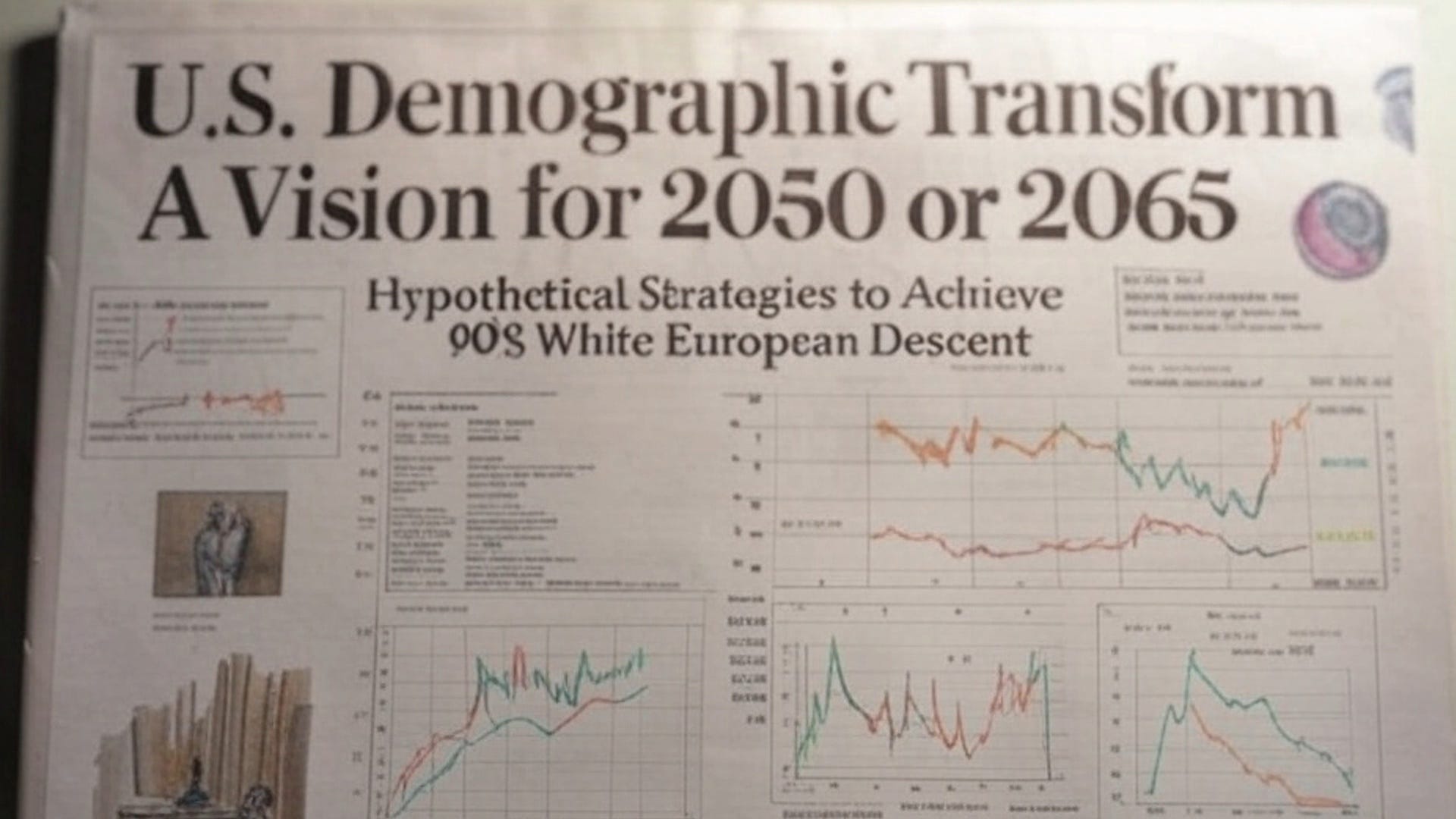
This essay imagines a future where the U.S. population shrinks and its demographic makeup shifts dramatically over decades. It explores various methods—legal, community-driven, and voluntary—to achieve this transformation, reflecting on past eras and long-term trends while considering the challenges and implications of such a change.
Introduction
The United States, projected to reach 345 million in 2025—based on 334 million in 2023 per the Census Bureau—envisions a hypothetical reduction to 250 million, aiming for a 90% White European-descended demographic (225 million) by 2050 or 2065. This speculative scenario, not advocating violence, imagines removing all Blacks (47 million), illegal immigrants and descendants (16–26 million), refugees and descendants (4.9–5.9 million), and new arrivals from non-White countries since 2020—including open border entrants and anchor babies (2–4 million)—totaling 73–85 million, with flexibility pre-2020. From a starting point of 60% White (204 million), 13% Black (44.2 million), 18% Hispanic (62 million), and 10% other (34.8 million), strategies include paid relocation, citizen-driven discrimination, and legal reinterpretation. This essay explores these possibilities, compares 2050 and 2065 to 1965 and a 100-year projection, considers White population variations (mixed-race, adoptions, unique families), and examines implications using Census, Pew, and ACS 2022 data.
Population and Demographic Baseline with Variation
In 2025, the U.S. population of 345 million far exceeds 1965’s 193 million, when Whites were the vast majority, Blacks a smaller group, and others—mostly Hispanics and a small Asian cohort—filled out the rest. Today’s White share, officially 60% (204 million), might range slightly due to mixed-race individuals (e.g., White-Hispanic or White-Asian), adoptions of non-White children by White families, or unique setups like White step-parents raising diverse stepchildren. Blacks are a notable presence, Hispanics a significant slice, and “other” a varied mix. Targeted groups include 47 million Blacks, 16–26 million illegal immigrants and descendants, 4.9–5.9 million refugees and descendants, and new arrivals from non-White countries since 2020, plus some from earlier years, totaling 73–85 million after overlaps. Removal reduces the population to a range just above 250 million, with Whites at 204 million (a stronger majority), Hispanics reduced, and others trimmed. To reach 250 million, more must leave, adjusting Whites from 204 million to 225 million (a modest gain) and cutting non-Whites to 25 million (a substantial loss). The final makeup targets 90% White (225 million) and 10% non-White (25 million), excluding targeted groups, with Whites possibly including mixed-race individuals, adopted children, or unique family blends, and the non-White 10% reflecting similar diversity.
Strategies for Transformation - Multiple hypothetical approaches could achieve this shift:
Enforce Past Laws - Naturalization Act of 1790: Reinstating the 1790 Naturalization Act, limiting citizenship to “free white persons,” could hypothetically revoke citizenship for non-Whites post-1790, targeting millions (e.g., Blacks, new arrivals from non-White countries) for removal without new laws. By 2050, this might remove millions yearly alongside deportation and birth control, totaling a hefty annual cut, or by 2065, a slower pace, reducing 345 million to 250 million while boosting White growth through selective naturalization to hit targets.
Enforce Current Laws: Existing laws like vagrancy, loitering, or public health regulations could be rigorously enforced to target Blacks, new arrivals from non-White countries, and anchor baby families, forcing departures yearly without new legislation. By 2050, paired with deportation and birth control, this could remove millions annually, or by 2065, a steadier drop, with enforcement extended pre-2020 as needed, dropping from 345 million to 250 million.
Other Legal Strategies: An expanded immigration system might deport millions yearly (illegals, refugees, new arrivals) while halting inflows, controlling births—non-White fertility sharply cut, White encouraged—removing millions annually by 2050 (with White growth) or by 2065 (with a smaller White increase), reducing 345 million to just above 250 million by mid-century and hitting the mark by the end.
Paid Relocation: Offering asset-selling aid (e.g., homes, cars) and a plane or bus ticket (a few hundred dollars) could see millions accept yearly by 2050, or fewer by 2065, encouraging voluntary exit to Africa or elsewhere. Paired with deportation and birth control, this removes millions annually (2050) or a slower rate (2065), supporting White growth to 225 million from 345 million to 250 million.
Law Repeal or Reinterpretation: Repealing the Civil Rights Act or reinterpreting it (e.g., ending nondiscrimination) could legalize exclusion, enabling citizen efforts, while enforcing current laws targets groups without new bills, extending pre-2020 as needed. By 2050, millions depart yearly; by 2065, a gentler pace, reducing 345 million to just above 250 million by mid-century and 250 million by target years.
Citizen and Community-Based Removal: Citizens might drive removal through discrimination—refusing service (e.g., denying housing, jobs, groceries), socially shunning, or harassing (e.g., vandalism, threats)—forcing millions out yearly. Reporting new arrivals since 2020 (or earlier) to authorities or forming exclusionary watch groups could amplify legal efforts from 345 million to 250 million.
Illegal Approach: Suppose covert efforts expelled millions annually by mid-century for 2050, or a slower pace for 2065, using vigilante actions like community raids, intimidation campaigns with anonymous threats, or sabotage such as cutting water or power to targeted areas, alongside secret birth prevention—distributing contraceptives covertly or tampering with medical services to curb non-White reproduction. White growth could occur through natural increase, encouraging larger families via community incentives, and selective immigration from White-majority regions, possibly via underground networks if legal channels falter, all as a speculative scenario not promoting violence.
Violent Tactics: Imagine forceful removal involving millions of departures annually by mid-century for 2050, or a slower clip for 2065, using physical confrontations led by citizen militias or rogue units targeting Black neighborhoods, new arrivals from non-White countries, and anchor baby families with actions like forced evictions or mob violence, followed by smaller reductions through sustained pressure like intimidation patrols. Whites could be selectively preserved and expanded via protected enclaves and incentivized reproduction with community support, ensuring 225 million, purely as a hypothetical not advocating violence.
War Scenario: Envision a conflict removing 83–107 million—millions yearly by mid-century for 2050, or a steadier rate for 2065—through orchestrated civil unrest or state-sanctioned campaigns targeting excluded groups, ensuring White dominance by safeguarding White populations in fortified areas while expelling or eliminating others, with post-conflict policies boosting White numbers to 225 million via birth incentives, all as a theoretical possibility not calling for violence.
Paid Relocation and Citizen-Driven Efforts
Paid relocation provides a simple exit: a ticket (plane or bus, $300–$500) and asset-selling help, managed by immigration agencies to encourage returns to Africa, Latin America, or elsewhere, costing far less than deportation’s billions overall. It’s a low-cost alternative to deportation, but success hinges on uptake—historically limited without coercion. Citizen-driven removal complements this—individuals and communities might refuse service (e.g., no housing, jobs, groceries for Blacks or new arrivals), socially isolate, or use intimidation (e.g., vandalism, threats), pushing millions out yearly alongside legal efforts, avoiding costlier deportation’s hefty total. For 2050, this duo demands rapid action; for 2065, it’s more gradual.
Comparing Timelines to 1965 and a Century-Long View
In 1965, the U.S. had 193 million—a smaller, less diverse nation than today’s 345 million or Pew’s 2065 projection of 441 million, with a shrinking White share and growing diversity. The 250 million target sits above 1965 but well below 2065, balancing growth from 1965 with a cut from future projections. The 90% White goal (225 million) exceeds 1965’s White dominance, erasing the Black presence and reducing non-Whites to a sliver from today’s broader mix, contrasting sharply with 2065’s diversity. Over 100 years (1965–2065), growth is reversed to a cut from 2025, landing at 250 million—a middle ground with a transformed racial profile.
2050 vs. 2065: Speed and Scale
2050 (25 Years): A brisk pace requires millions in annual removals—via paid relocation, citizen efforts, deportation—plus birth control and White growth through births and immigration. From 345 million to 250 million in 25 years, it’s a swift shift risking upheaval by mid-century.
2065 (40 Years): A slower pace allows fewer millions annually—relocation, citizens, deportation—with White growth spread out. It’s a steadier path over 40 years.
Implications and Broader Context
Both timelines reshape the U.S. beyond 1965’s diversity or 2065’s pluralism. The White increase includes mixed-race individuals, adopted non-White children, and unique family blends, while the 10% non-White (25 million) might reflect similar overlaps. The 2050 rush risks collapse; 2065 offers adaptability—both demand extraordinary shifts.
Conclusion
Achieving 250 million with 90% White by 2050 or 2065 removes 73–85 million targeted groups—Blacks, illegal immigrants and descendants, refugees and descendants, new arrivals from non-White countries since 2020 (with pre-2020 flexibility)—and more, growing Whites from 204 million to 225 million—a gain reflecting mixed-race ties, adoptions, and family diversity. This exceeds 1965’s 193 million with its White majority, erasing Black presence, and cuts deeply from 2065’s diverse swell. The 2050 pace demands intense removals—destabilizing by mid-century—while 2065’s spreads the effort, balancing White growth with less strain. Paid relocation—a ticket and asset help—softens legal efforts, citizen-driven discrimination (refusal of service, shunning) and law repeal (e.g., Civil Rights Act) amplify it by millions yearly, leveraging community pressure. Over 100 years (1965–2065), this reverses growth into a cut, landing between eras but redefining identity—90% White vs. 1965’s share and 2065’s blend. Legal hurdles (14th Amendment), economic fallout (workforce loss), and societal resistance dwarf historical efforts, making this a profound, contentious shift, presented as a hypothetical exploration.
500-Word Summary
The idea envisions a future where the U.S. population decreases significantly from its current size and reshapes its demographic profile to emphasize a majority of European-descended individuals by mid-century or slightly later. Starting from a present-day population that’s notably larger and more diverse than it was decades ago, the goal is to reduce the total number of people while increasing the proportion of one ancestral group to a dominant level, leaving a small share of others. This speculative scenario considers removing specific groups—such as long-standing minorities, recent immigrants and their families, refugees, and new arrivals from certain regions—while allowing flexibility with earlier arrivals.
The current U.S. population reflects a mix of ancestries, with one group holding a majority, though less dominant than in the past, alongside significant minority communities. The targeted reduction would involve shrinking the overall population and adjusting this balance, boosting the majority group’s presence while sharply cutting others. This could include individuals of mixed heritage, adopted children, or unique family structures within the majority, with the remaining minority share reflecting similar diversity.
Several strategies are explored to achieve this shift. One approach involves reviving old laws that once restricted citizenship to a specific group, potentially pushing out those who don’t qualify over time. Another method uses existing regulations—like those addressing public behavior or health—to encourage departures without new legislation. Expanding immigration enforcement could also play a role, deporting certain groups while halting new entries and adjusting birth patterns to favor the majority. Offering financial incentives, such as help selling assets and travel assistance, might encourage voluntary exits to other countries, reducing the population gradually. Reinterpreting or removing civil rights protections could empower communities to exclude others legally, while grassroots efforts—like denying services or social pressure—might amplify the effect. More extreme, hypothetical ideas include covert actions or even conflict, though these are presented as thought experiments, not endorsements.
The timeline matters. A faster pace by mid-century demands swift, intense efforts—relocation, community actions, and legal changes—risking disruption. A longer horizon, stretching a decade or two further, allows a steadier approach, spreading out the transformation with less immediate strain. Compared to the past, when the population was smaller and less diverse, this vision exceeds that era’s majority dominance while falling short of future projections that anticipate even greater growth and variety. Over a century, it reverses expansion into a deliberate cut, landing between historical simplicity and forecasted complexity.
The implications are broad. The majority group’s growth could include diverse family ties, while the remaining minority might mirror that complexity. A rapid shift risks instability; a slower one offers flexibility. Legal challenges, economic reliance on a varied workforce, and social pushback loom large, dwarfing past efforts at control. Voluntary relocation—offering travel and asset support—softens the process, while community-driven exclusion adds momentum. This exploration, rooted in current trends and historical context, presents a hypothetical reimagining of the nation’s identity, not a call to action, highlighting the scale and stakes of such a change.
#FutureDemographics #PopulationShift #USVision #HeritageFocus #SpeculativeChange
Watch video on X, Rumble, Odysee, BitChute, Brighteon, Facebook, Gab, Gettr, Minds, or realfreenews.com